Ultimate Guide to Data Privacy Officer Certifications
Key Takeaways:
- Demand for DPOs is rising: Privacy roles are projected to grow by 33% from 2023 to 2033.
- Earning potential: Privacy Managers can earn up to $196,000 annually (as of February 2026).
- Top certifications:
- CIPP (Certified Information Privacy Professional): Focuses on privacy laws.
- CIPM (Certified Information Privacy Manager): Covers privacy program management.
- CIPT (Certified Information Privacy Technologist): Emphasizes technical implementation.
- CDPSE (Certified Data Privacy Solutions Engineer): Targets data lifecycle management.
- Global relevance: Certifications align with regulations like GDPR (Europe), CCPA (U.S.), LGPD (Brazil), and APPI (Japan).
Choosing the Right Certification:
- Legal focus: Start with CIPP (e.g., CIPP/E for GDPR).
- Operational focus: CIPM is ideal for managing privacy programs.
- Technical roles: CIPT or CDPSE suits IT professionals.
- Experienced professionals: Consider PECB's Certified DPO for GDPR-specific tasks.
Certification Costs & Maintenance:
- Exams range from $395 to $1,500.
- Maintenance requires 20 CPE credits every two years (IAPP certifications).
Whether you're new to privacy or an experienced professional, certifications like CIPP and CIPM can significantly boost your career prospects in this fast-growing field.
What Data Protection Officer (DPO) Training and Certification are available?
sbb-itb-6487feb
Understanding the Data Privacy Officer Role and Certification Options
The role of a Data Privacy Officer (DPO) goes far beyond simply ensuring compliance. DPOs are tasked with managing privacy regulations, acting as a communication bridge with authorities, and translating legal requirements into actionable frameworks like Records of Processing Activities (RoPA), Data Protection Impact Assessments (DPIAs), and breach response plans. This broad scope highlights the importance of certifications that validate both legal and operational expertise.
DPOs play a key role in conducting and advising on DPIAs for high-risk data processing activities. They also lead privacy incident response efforts and oversee breach notification protocols. But their work doesn’t stop there. Today’s DPOs are expected to embed "Privacy by Design" principles into organizational strategies, product development, and technical architectures, turning regulatory demands into practical processes.
"The DPO serves as the organization's privacy expert and regulatory liaison."
- Kevin Yun, Author, Complydog
Under GDPR Article 37, DPOs are protected to ensure their independence, emphasizing the value of certifications that verify their expertise. Understanding these responsibilities makes it clear why certifications are critical for navigating the complex requirements of global and regional privacy laws.
Why Certifications Matter for DPOs
Certifications act as a kind of "specialized license", showcasing a DPO's expertise, boosting earning potential, and demonstrating a company's commitment to compliance for regulators and partners alike. For example, the International Association of Privacy Professionals (IAPP) offers core certifications like CIPP/E, CIPP/US, CIPM, and CIPT, which are accredited by the ANSI National Accreditation Board under ISO/IEC 17024. These certifications provide independent verification of professional skills.
Beyond financial benefits, certifications help DPOs build credibility with both executives and regulatory authorities, especially when fulfilling GDPR’s mandatory DPO appointment requirements.
The certification market is led by organizations such as IAPP, ISACA, and (ISC)², with credentials tailored to different facets of the DPO role. For instance:
- Legal expertise: Certified Information Privacy Professional (CIPP)
- Operational management: Certified Information Privacy Manager (CIPM)
- Technical safeguards: Certified Information Privacy Technologist (CIPT) and Certified Data Privacy Solutions Engineer (CDPSE)
Each certification focuses on a specific area, from mastering jurisdictional laws to implementing privacy programs and technical controls.
How Global and Regional Regulations Affect Certification Choices
Privacy regulations directly influence which certifications professionals pursue. For example, the GDPR drives European practitioners to seek the CIPP/E for legal knowledge and the CIPM for operational compliance. These two certifications together are often seen as the "gold standard" for meeting GDPR DPO requirements. The CIPP/E exam is available in English, French, and German, while the CIPM exam is offered in multiple languages, including Chinese and Brazilian Portuguese.
In the United States, with its complex mix of federal and state laws like CCPA/CPRA and HIPAA, the CIPP/US certification is a popular choice. This credential focuses on sector-specific frameworks. Similarly, Brazil’s LGPD has prompted professionals to pursue regional certifications like the IAPP’s CDPO/BR. Meanwhile, the EU AI Act has introduced new challenges, encouraging DPOs to obtain credentials such as the Artificial Intelligence Governance Professional (AIGP).
"Privacy is not black and white; it is a lot of gray. You have to find what works best for you."
- Ksenia Laputko, Privacy Professional and Educator
The rise of privacy-enhancing technologies (PETs) and automation tools for consent management and DSAR processing has also increased demand for technical certifications like CIPT and CDPSE. As DPOs face the challenge of balancing legal expertise with technical know-how, choosing the right certifications becomes essential for managing data minimization, retention policies, and complex data pipelines. These evolving regulatory and technological demands make certification decisions a key factor in advancing a DPO’s career.
Best Certifications for Data Privacy Officers
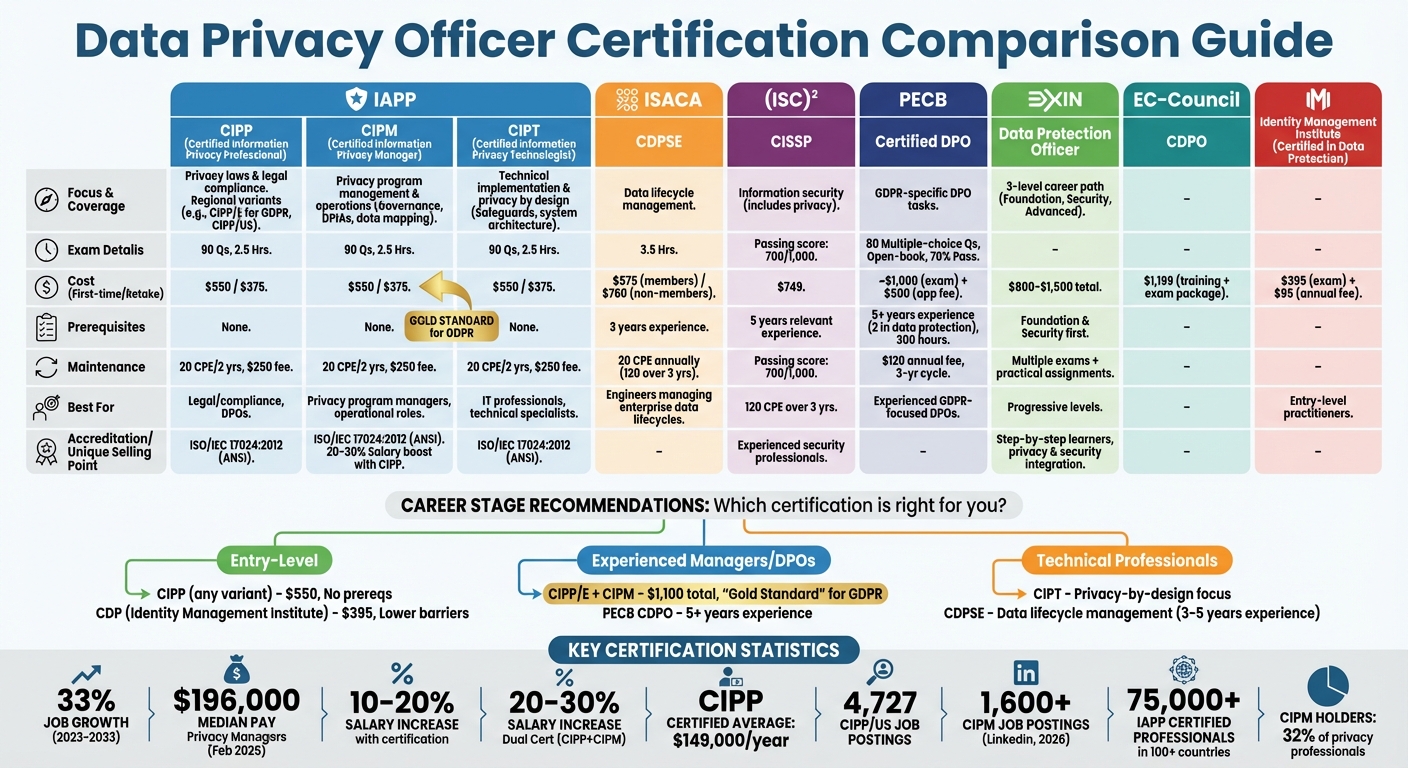
Data Privacy Officer Certification Comparison Guide 2026
When it comes to certifications in data privacy, the International Association of Privacy Professionals (IAPP) stands out with its globally acknowledged credentials: CIPP, CIPM, and CIPT. These certifications are accredited under ISO/IEC 17024:2012 by the ANSI National Accreditation Board. The exams cost $550, consist of 90 questions, and must be completed in 2.5 hours.
The CIPP certification is tailored to specific regions, offering options like CIPP/E for Europe (focused on GDPR), CIPP/US for U.S. federal and state laws, CIPP/C for Canada, CIPP/A for Asia, and CIPP/CN for China. Meanwhile, the CIPM dives into operational privacy management, helping professionals develop and oversee privacy programs, manage vendor relationships, and establish governance frameworks. On the other hand, the CIPT is geared toward technical specialists, focusing on implementing privacy by design principles.
Beyond IAPP, other certifications also provide valuable opportunities for data privacy professionals to elevate their skills:
- ISACA's Certified Data Privacy Solutions Engineer (CDPSE): Requires three years of experience and involves a 3.5-hour exam. The cost is $575 for ISACA members and $760 for non-members.
- (ISC)²'s CISSP: Aimed at experienced professionals, this certification requires five years of relevant work, a passing score of 700 out of 1,000, and costs $749.
For those pursuing Certified Data Protection Officer credentials, options include:
- EC-Council: Offers training and an exam package priced at $1,199.
- PECB: Charges approximately $1,000 for the lead exam, plus a $500 application fee.
- EXIN: Provides a variety of certification paths.
- Identity Management Institute's Certified in Data Protection: Costs $395 for the exam, with an additional $95 annual fee.
These certifications cater to diverse career stages, allowing professionals to choose a path that aligns with their goals and experience.
In response to emerging challenges, IAPP introduced the Artificial Intelligence Governance Professional (AIGP) certification in 2024. This certification focuses on the ethical and regulatory management of AI systems. Additionally, for seasoned professionals seeking to showcase expertise across legal, management, and technical domains, the Fellow of Information Privacy (FIP) designation is a prestigious option. To qualify, candidates must hold at least one CIPP certification along with either a CIPM or CIPT.
Certified Information Privacy Professional (CIPP)
The CIPP certification is a key credential for understanding privacy laws and compliance - the "what" of data protection. It’s tailored for professionals who manage personal data, such as Data Protection Officers, compliance experts, HR managers, and IT specialists.
What makes the CIPP stand out is its focus on regional privacy laws. Candidates choose from six concentrations based on the jurisdiction relevant to their work:
- CIPP/US: Covers U.S. federal and state laws, including HIPAA, FCRA, and CCPA/CPRA.
- CIPP/E: Focuses on European regulations, particularly the GDPR.
- CIPP/C: Addresses Canadian privacy laws like PIPEDA and provincial regulations.
- CIPP/A: Examines privacy frameworks in select Asian economies, such as Singapore, Japan, and South Korea.
- CIPP/CN: Centers on China’s privacy laws, including PIPL, DSL, and CSL.
- CIPP/G: Designed for professionals working in the U.S. government sector.
For those aiming to become Data Protection Officers in the EU, combining the CIPP/E with the CIPM is generally considered essential for meeting GDPR expertise requirements.
Exam Details and Costs
The CIPP exam includes 90 multiple-choice questions (75 scored and 15 unscored pretest items) and must be completed in 2.5 hours. It’s available through Pearson VUE testing centers or online proctoring. To pass, candidates need a scaled score of 500 out of a possible range of 300 to 800. The test focuses on applying legal knowledge to practical scenarios rather than memorization, with first-time pass rates typically around 70–75%.
- Exam Fees: $550 for first-time takers; $375 for retakes or those holding another IAPP certification.
- Certification Maintenance Fee: $250 every two years (waived for IAPP members, whose annual membership costs about $295).
- Study Materials: Official practice exams cost $55, and textbooks range from $150 to $200.
Although the IAPP recommends at least 30 hours of study, professionals without a legal background often require 10–14 weeks of preparation. A good starting point is the official Body of Knowledge and Exam Blueprint, along with the IAPP textbook, which serves as the definitive study resource.
Career Benefits
CIPP certification can significantly boost earning potential. Certified professionals earn an average salary of $149,000 per year, which is 10–20% higher than their non-certified counterparts. A recent job search revealed 4,727 openings specifically seeking CIPP/US-certified candidates. With over 75,000 IAPP-certified professionals in more than 100 countries, the CIPP is widely acknowledged as a leading credential in privacy certification.
Certified Information Privacy Manager (CIPM)
The CIPM certification shifts the focus from understanding privacy laws (as emphasized by the CIPP) to managing privacy programs effectively. This credential is the only one dedicated solely to privacy program management and holds accreditation from the ANSI National Accreditation Board (ANAB) under ISO 17024:2012.
The CIPM curriculum spans six key areas: creating privacy frameworks, setting up governance structures, conducting privacy impact assessments and data mapping, safeguarding personal data through policies and training, maintaining program performance with metrics and audits, and addressing data subject requests and incidents. Unlike certifications centered on legal aspects, the CIPM caters to a wide audience, including privacy program managers and professionals in IT, HR, marketing, and other roles where privacy integration is essential.
Exam Details and Costs
The CIPM exam is designed to test program management skills and includes 90 multiple-choice questions (75 scored and 15 unscored pretest items). Candidates have 2.5 hours to complete the exam, and a passing score of 300 on a scale of 100 to 500 is required. The questions range from simple knowledge checks to complex, scenario-based problems that evaluate the application of privacy principles in practical business contexts.
The exam fee is $550 for first-time candidates and $375 for retakes, with a mandatory 30-day waiting period between attempts. Certification maintenance fee: $250 every two years, though this is waived for active IAPP members ($295 annual membership). While the IAPP suggests a minimum of 30 hours of study, many candidates dedicate 40 to 50 hours to preparation.
Career Benefits and Study Resources
The CIPM certification is held by 32% of privacy professionals, and by early 2026, over 1,600 job postings on LinkedIn specifically sought CIPM-certified individuals. Combining CIPM with another certification like CIPP can boost salaries by 20% to 30%, with certified professionals earning as much as $15,000 more annually compared to their non-certified peers.
"The CIPM designation is the gold standard for privacy professionals looking to verify their expertise in the functional management of personal data." – Privacy Bootcamp
For study resources, the IAPP Body of Knowledge and the "Privacy Program Management" textbook (3rd Edition) by Russell Densmore provide essential insights for tackling real-world privacy challenges. Prioritize high-weight areas such as privacy governance and policies, and work through scenario-based questions to sharpen analytical skills. To maintain certification, professionals must complete 20 hours of Continuing Privacy Education (CPE) every two years.
Up next, we’ll explore other certifications that further enhance a DPO’s skill set.
Certified Data Protection Officer (CDPO)
When it comes to Data Protection Officer (DPO) certifications, the Certified Data Protection Officer (CDPO) designation offers several alternatives to IAPP's well-known credentials. These pathways, provided by EXIN, PECB, and IAPP (through its CIPP/E + CIPM combination), cater to different career goals and regional needs. Each certification body takes a unique approach, so understanding their structures can help you decide which one best aligns with your professional objectives.
EXIN's Data Protection Officer certification follows a modular structure, requiring candidates to complete three levels: Privacy & Data Protection Foundation, Information Security, and an Advanced level that includes hands-on assignments. While this approach builds expertise step-by-step, it demands more time and financial commitment compared to single-exam certifications. However, if you already hold the IAPP CIPM credential, EXIN allows you to bypass the Foundation level.
PECB's Certified Data Protection Officer emphasizes the specific responsibilities outlined in the GDPR, such as managing subject access requests and conducting Data Protection Impact Assessments (DPIAs). To qualify, candidates need at least five years of professional experience (with two years focused on data protection) and 300 hours of documented work. The exam consists of 80 multiple-choice questions, requires a 70% passing score, and is open-book - unlike IAPP's closed-book format.
Meanwhile, IAPP's CIPP/E combined with CIPM remains a globally respected option. According to IAPP:
"GDPR requires DPOs to have 'expert knowledge' of data protection law, making CIPP/E essential. CIPM isn't legally required but is increasingly preferred by employers because DPOs must both understand law (CIPP) and implement programs (CIPM)".
This dual-certification path has no prerequisites, making it accessible to newcomers while still being valued by employers. Each exam costs $550, and the straightforward structure appeals to professionals seeking a recognized credential without significant pre-certification requirements.
Comparing CDPO Options
Here’s a summary of how these certifications differ:
| Feature | EXIN Data Protection Officer | PECB Certified DPO | IAPP (CIPP/E + CIPM) |
|---|---|---|---|
| Structure | Career path (3 separate certifications) | Single certification program | Dual certification (Legal + Management) |
| Exam Format | Multiple exams; Advanced includes practical assignments | 80 multiple-choice questions; open-book | 90 questions each; 2.5 hours per exam |
| Prerequisites | Must complete Foundation and Security modules first | 5+ years experience; 300 hours documented work | None |
| Regional Focus | International; heavy EU GDPR focus | Global; specific GDPR DPO obligations | CIPP/E is Europe-specific; CIPM is Global |
| Total Cost | $800–$1,500 | $1,500 | $1,100 |
| Maintenance | Progressive certification levels | $120 annual fee | 20 CPEs every 2 years per certification |
Each certification pathway has its strengths. IAPP is a solid choice for those seeking globally recognized credentials with minimal prerequisites. PECB is better suited for experienced professionals who prefer ISO-aligned frameworks. EXIN offers a step-by-step learning path that integrates privacy and information security, making it a good fit for those who value gradual skill-building. These options cater to diverse career stages and regional focuses, giving professionals the flexibility to choose what works best for their goals.
How to Choose the Right Certification for Your Career
Selecting the right certification can play a significant role in advancing your career in data privacy. Certifications like CIPP and CIPM, highlighted in our guide, can align with your expertise and career goals, while also meeting the demands of your target roles. On average, privacy professionals with certifications earn 10–20% more than their uncertified peers, and holding dual certifications such as CIPP and CIPM can increase salaries by 20–30%.
Start by defining your area of focus. If your work revolves around legal or compliance, understanding privacy laws and regulations is crucial, making the CIPP a great fit. For those in operations or program management, the CIPM equips you with the skills to build and manage privacy programs. IT and engineering professionals should consider certifications like CIPT or CDPSE, which emphasize integrating privacy into systems and software. As the International Association of Privacy Professionals (IAPP) puts it: CIPP defines the rules, while CIPM shows how to implement them.
Geographic considerations are equally important. The CIPP is available in regional variants - CIPP/US for U.S. law and CIPP/E for European GDPR compliance. Of these, CIPP/E is often regarded as the most globally relevant due to the GDPR’s widespread influence.
Experience requirements also play a role. Certifications like CIPP, CIPM, and CIPT from IAPP don’t require prior experience, making them accessible to newcomers. On the other hand, certifications like CDPSE typically require about three years of experience, while credentials such as CISSP and PECB CDPO often demand five years. If you’re early in your career, starting with a knowledge-based certification like the CIPP can be a smart move. As you gain experience, you can pursue certifications that validate practical expertise.
Here’s a breakdown of certification options based on career stage and focus:
Entry-Level Practitioners
For those just starting out or transitioning into privacy, the CIPP is a strong starting point. It provides a solid understanding of privacy laws and regulatory frameworks without requiring prior experience. Choose the regional variant that aligns with your jurisdiction - CIPP/US for U.S. privacy laws or CIPP/E for GDPR compliance. For a more general entry point, consider the Certified in Data Protection (CDP) from the Identity Management Institute, which costs $395 and has fewer entry barriers.
Experienced Managers and DPOs
If you’re managing privacy programs or aspiring to a Data Protection Officer (DPO) role, you’ll need to demonstrate both legal knowledge and operational skills. Many employers favor the combination of CIPP/E and CIPM, as it shows you understand both the regulations and the practical steps for compliance. GDPR requires DPOs to have "expert knowledge" of data protection law, reinforcing the importance of comprehensive certifications. Dual certifications cost around $1,100 and can significantly boost your credibility and earning potential. If you have at least five years of experience (including two years in data protection), the PECB CDPO is another option, focusing on GDPR-specific DPO tasks like handling subject access requests and conducting Data Protection Impact Assessments.
Technical Professionals
For IT professionals focused on integrating privacy into technology, the choice depends on your specific role. The CIPT (Certified Information Privacy Technologist) is designed for those working on privacy-by-design principles. Meanwhile, ISACA’s Certified Data Privacy Solutions Engineer (CDPSE) targets engineers managing enterprise data lifecycles and typically requires three to five years of technical experience. Opt for CIPT if your role leans toward privacy-focused solutions, or choose CDPSE if your work centers on data lifecycle management.
Maintaining Your Certification and Continuing Education
Earning a certification is an important milestone, but keeping it up to date is just as critical. Maintaining your certification ensures you stay aligned with the latest privacy standards and industry practices. This process typically involves earning designated Continuing Professional Education (CPE) credits within specific cycles, proving your knowledge remains current.
IAPP Certification Maintenance Requirements

For certifications like CIPP, CIPM, and CIPT, the International Association of Privacy Professionals (IAPP) requires you to earn 20 CPE credits every two years. To help you stay on track, the IAPP sends reminders 90, 30, and 7 days before your deadline. You can earn these credits by participating in activities such as attending conferences, reading privacy-related materials, completing online courses, or engaging in professional speaking and mentoring.
To encourage a variety of learning experiences, the IAPP places limits on certain activities. For instance, you can't fulfill all 20 credits just by reading news articles. If you hold multiple IAPP certifications, you can apply credits from a single activity to more than one certification if the content is relevant. As the IAPP explains:
"We believe it will be rare that people with multiple credentials will need to earn 20 unique credits for each designation".
The IAPP also simplifies deadlines by aligning the CPE credit due dates for all certifications you hold. If you earn non-IAPP credits, they must be submitted within 90 days of completion. Surplus credits earned during the final six months of your cycle can be carried over - up to 10 credits. For resources, the IAPP's "CPE Central" portal offers curated options, including free and paid content filters.
For non-members, the Certification Maintenance Fee (CMF) is $250 every two years. Alternatively, you can opt for an IAPP Professional Membership, which costs $295 annually and includes the CMF. Membership also provides perks like discounts on study materials, conferences, and KnowledgeNet Chapters. Reduced-rate memberships are available for government, non-profit, or higher education professionals ($110 annually) and students ($50 annually).
Other certification bodies also have specific renewal cycles and fees designed to keep professionals up to date.
Maintenance Requirements Across Different Certification Bodies
Different organizations set their own rules for maintaining certifications. For example, ISACA, which offers certifications like CDPSE, requires 20 CPE credits annually (a total of 120 credits over three years). Similarly, (ISC)² certifications, such as CISSP, also require 120 CPE credits within a three-year cycle. PECB's CDPO certification follows a three-year renewal cycle based on ISO/IEC 17024 standards. Both ISACA and (ISC)² charge annual fees in addition to their CPE requirements.
Here’s a quick comparison of maintenance requirements across major certification bodies:
| Certification Body | CPE Requirement | Cycle Duration | Maintenance Fee |
|---|---|---|---|
| IAPP (CIPP, CIPM, CIPT, AIGP) | 20 CPEs | 2 Years | Included in membership or $250 CMF |
| ISACA (CDPSE, CISA, CISM) | 20 per year; 120 total | 3 Years | Annual maintenance fee |
| (ISC)² (CISSP, CCSP, CGRC) | 120 CPEs | 3 Years | Annual maintenance fee |
| PECB (CDPO) | Varies | 3 Years | Based on ISO/IEC 17024 scheme |
Certification bodies often conduct audits to verify your submitted activities, so it's a good idea to keep detailed records of your continuing education. Regularly check your certification dashboard to track your CPE status and deadlines. Submitting documentation promptly after completing an activity will help you stay compliant.
Exam Preparation Tips and Resources
Preparing effectively for your exam is crucial for demonstrating your knowledge and advancing your career as a Data Protection Officer (DPO). While the IAPP suggests dedicating 30 hours to studying, most candidates invest between 40–80 hours over 2–4 months, depending on the certification and their familiarity with the material. For example, certifications like CIPP/E or CIPP/US typically require 40–60 hours of preparation, while the CIPM often demands 50–70 hours.
Official Training Programs and Study Guides
A solid starting point is the Body of Knowledge (BoK) and Exam Blueprint, both of which are freely available from the IAPP. The BoK outlines all the concepts covered in the exam - if a topic isn’t listed there, it won’t appear on the test. The Exam Blueprint breaks down the number of questions per topic, helping you focus your study efforts. Before diving into study materials, take advantage of the free IAPP mini-course, "How to prepare for an IAPP certification," to create a tailored study plan.
The IAPP offers official training in various formats to suit different learning preferences, including self-paced online modules, live virtual classrooms, in-person sessions, and group training. These programs are designed around the BoK but do not include actual exam questions. Additionally, practice exams with 90 questions are available to simulate the test experience and assess your readiness. To ensure quality, stick to IAPP Official Training Partners and steer clear of unauthorized trainers who promise guaranteed passing scores.
If you’re juggling a full-time job with your studies, self-study techniques can help you make the most of your time.
Self-Study Strategies and Tips
Self-study can be a powerful complement to formal training. Use the BoK as a checklist to track your progress across each exam topic. For those with busy schedules, spreading your study sessions over several months and incorporating learning into daily activities - like reading industry newsletters during breaks - can be particularly effective. Reviewing the official IAPP Glossary of Privacy Terms is another great way to familiarize yourself with the terminology used in exam questions.
Practice tests are invaluable for preparing under exam-like conditions. They allow you to review key content while honing your time management skills. IAPP exams consist of 90 questions with a 2.5-hour time limit, so practicing within these constraints is essential. After purchasing your exam, you have a full year to schedule and complete it, giving you plenty of time to prepare.
If you don’t pass on your first attempt, don’t worry - you’ll receive a detailed breakdown showing the percentage of correct answers by domain. This feedback can guide your preparation for a retake.
Conclusion: Advancing Your Career as a Data Privacy Officer
Earning a data privacy certification can give your career a powerful boost. With demand for privacy officers and information security analysts expected to grow by 33% between 2023 and 2033, this field offers one of the fastest-growing career paths in the U.S. As of February 2026, the median total pay for an Information Privacy Manager in the country is $196,000.
Whether you're aiming for the CIPP to deepen your legal expertise, the CIPM to lead privacy programs, or the CIPT to focus on technical implementation, each certification can unlock new professional opportunities. These credentials validate your expertise in privacy laws like GDPR and CCPA, making your resume more appealing to automated applicant tracking systems and giving you an edge in a competitive job market. In fact, a 2026 job board search showed over 2,925 active listings specifically seeking candidates with the CIPM designation. To maintain career momentum, ongoing education is essential.
Certifications require more than just passing an exam - they demand commitment. Staying certified means earning 20 CPE credits every two years to keep up with evolving regulations. You can also build expertise by engaging with professional networks, observing senior colleagues during Privacy Impact Assessments, or dedicating 15–30 minutes daily to staying updated on privacy news.
Tools like JobLogr can help turn your certifications into tangible career opportunities. This AI-powered platform tailors your resume to specific DPO job descriptions, emphasizing certifications like CIPP/E or CIPM to help you stand out to recruiters. It also generates personalized cover letters and guides you on industry-specific requirements - whether you're focusing on HIPAA for healthcare roles or financial privacy regulations for banking positions.
FAQs
Which certification should I get first for a DPO role?
The Certified Information Privacy Professional (CIPP) is often the go-to certification for those aiming to step into a Data Privacy Officer (DPO) role. It equips you with essential knowledge about privacy laws and compliance frameworks. To get started, choose the regional variant that aligns with your area, such as CIPP/E for Europe. After gaining a solid foundation, you can build on your expertise with more focused certifications like the Certified Information Privacy Manager (CIPM) or Certified Information Privacy Technologist (CIPT).
Do I need both CIPP and CIPM to qualify under GDPR?
You don’t need to have both CIPP/E and CIPM certifications to meet GDPR requirements. However, earning both can provide a more comprehensive skill set. CIPP/E focuses on European data protection laws, while CIPM emphasizes the operational management of privacy programs. Together, they can enhance your knowledge and prepare you more effectively for GDPR compliance challenges.
How do I maintain these certifications without burning out?
To keep up with your data privacy certifications without burning out, it's all about balance and smart planning. Space out your certification updates so they feel more manageable, and make sure to set clear boundaries to protect your personal time. Focus on certifications that align closely with your career goals to make the process more meaningful. Don’t forget to tap into your professional network for advice and support - they can be a great resource. With a thoughtful approach, you can maintain your certifications without feeling overwhelmed.