8 Jobs Requiring Advanced AI Certifications
AI certifications are becoming essential for high-paying, in-demand roles. As companies increasingly adopt artificial intelligence, professionals with advanced certifications are earning competitive salaries and securing positions in fields like Machine Learning, Data Science, and MLOps. These roles prioritize practical experience and validated expertise, with some certifications boosting salaries by 20–30%.
Key AI roles that require certifications include:
- Machine Learning Engineer: Average salary of $162,079; certifications like Google Professional ML Engineer and AWS ML Specialty are highly valued.
- Data Scientist: Median salary of $145,000; certifications like Microsoft Azure Data Scientist Associate and SAS Certified Data Scientist are critical.
- AI Research Scientist: Salaries range from $95,000 to $440,000; advanced degrees and certifications like USAII CAIS™ are often required.
- Computer Vision Engineer: Median pay of $162,000; certifications include NVIDIA’s Deep Learning for Computer Vision.
- NLP Engineer: Average salary of $123,604; certifications like Microsoft Azure AI Engineer Associate and Hugging Face NLP Specialization are recommended.
- AI Ethics Officer: Salaries up to $310,000; certifications like IEEE CertifAIEd™ and CCAIEO are crucial.
- MLOps Engineer: Salaries reach $310,000+; certifications like AWS ML Engineer and Google Professional ML Engineer are key.
- Robotics Engineer: Median salary of $178,000; certifications like AI+ Robotics™ and ROS Certification are valuable.
Employers are prioritizing skills-based hiring, with certifications proving expertise in deploying AI solutions. These roles not only offer high salaries but also demand hands-on experience, technical skills, and the ability to deliver measurable results in production environments.
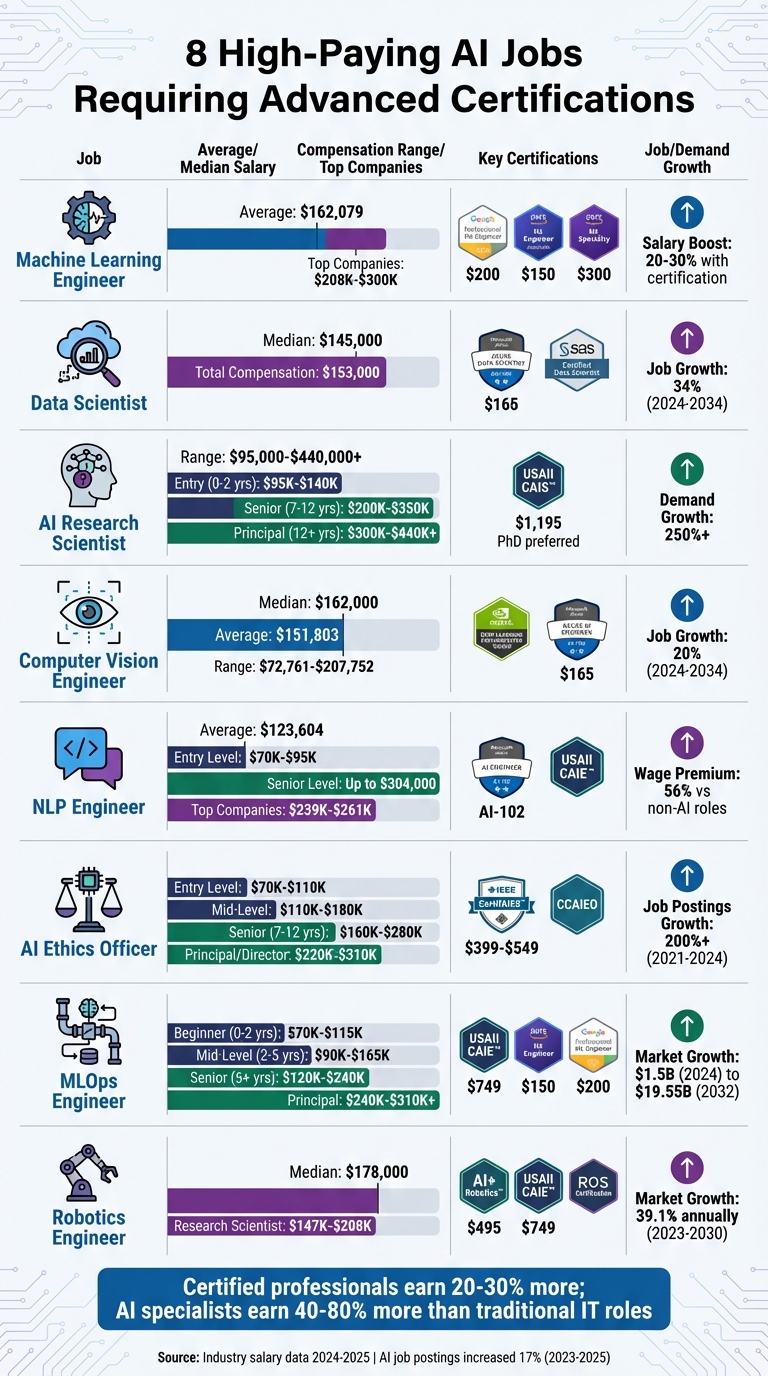
8 High-Paying AI Jobs: Salaries, Certifications, and Requirements Comparison
1. Machine Learning Engineer
Role Responsibilities
Machine Learning Engineers play a critical role in bridging the gap between prototype models and real-world applications. Their work involves designing, building, training, scaling, and deploying machine learning (ML) models for tasks like classification, prediction, forecasting, and clustering. They also develop and automate data and ML pipelines to ensure code is reusable and efficient. Beyond this, they monitor and retrain models to maintain accuracy, create generative AI solutions (such as large language models and agent-based systems), and implement ethical AI practices with strong data governance.
A notable example of this work is Scale AI's efforts in 2025, where models were deployed for government systems used by the Army and Air Force. Their team developed agent-based systems and fine-tuned pipelines using reinforcement learning frameworks.
To excel in this role, professionals often pursue certifications that validate their technical skills and hands-on experience.
Required Advanced Certifications
Several certifications highlight the expertise needed for this position:
- Google Professional Machine Learning Engineer ($200): This certification is ideal for professionals with at least three years of experience. It focuses on building, evaluating, and deploying AI solutions on Google Cloud.
- AWS Certified Machine Learning Engineer – Associate ($150): Aimed at individuals with a minimum of one year of experience implementing ML workloads.
- AWS Certified Machine Learning – Specialty ($300): Designed for those with over two years of experience, this certification covers a wide range of modeling topics. It will retire on March 31, 2026.
- Additional certifications include the Microsoft Certified: Azure AI Engineer Associate and the Google TensorFlow Developer Certificate, which are also highly regarded in the field.
Key Technical Skills
Proficiency in Python is essential, often paired with other programming languages like SQL, Java, R, and C++. Familiarity with frameworks such as TensorFlow, PyTorch, Keras, and Spark is critical. A strong grasp of statistics, probability, calculus, and linear algebra is equally important. Engineers should also be well-versed in cloud platforms like Google Cloud's Vertex AI and AWS SageMaker, as well as MLOps principles. Specializations in areas such as Computer Vision, Natural Language Processing, Reinforcement Learning, and Generative AI are increasingly valuable.
US Salary Range
Machine Learning Engineers in the United States earn an average annual salary of $162,079, with top-tier companies offering between $208,000 and $300,000 in major tech hubs. Certified professionals often see a salary boost of 20% to 30%, while AI specialists can command 40% to 80% more compared to traditional IT roles. This makes advanced certifications not just a technical asset but also a pathway to significantly higher earning potential in competitive markets.
2. Data Scientist
Role Responsibilities
With the growing demand for AI-certified professionals, Data Scientists have become essential in turning raw data into meaningful business strategies. Their work involves the entire process of transforming data - from identifying and cleaning datasets to preparing them for analysis. They also manage ingestion pipelines and design, train, validate, and deploy machine learning models to tackle complex challenges.
In addition to these tasks, Data Scientists fine-tune large language models for specific use cases, implement retrieval-augmented generation (RAG) systems, and create agent architectures. They oversee scalable machine learning solutions using tools like MLflow, ensuring smooth operation and performance. By translating data into clear, actionable insights through visualization, they also craft interactive, multi-topic conversational systems that interpret user intent effectively.
These responsibilities highlight the importance of advanced certifications that demonstrate both technical and practical expertise in this evolving field.
Required Advanced Certifications
The Microsoft Certified: Azure Data Scientist Associate (DP-100) certification (exam fee: $165) confirms proficiency in implementing machine learning solutions on Azure using Python, MLflow, and Azure Machine Learning. It now also covers Azure AI Foundry and language model optimization. Another valuable credential is the SAS Certified Data Scientist, which combines the "Advanced Programming Professional" and "AI & Machine Learning Professional" certifications. The latter requires passing three specialist exams on Machine Learning, Forecasting and Optimization, and NLP/Computer Vision. These certifications are valid for five years and need recertification afterward.
These certifications, paired with a solid foundation in technical skills, are critical for thriving in this role.
Key Technical Skills
Data Scientists must be proficient in programming languages like Python, R, and SQL. They should also be adept at using machine learning libraries (such as NumPy, pandas, and scikit-learn), deep learning frameworks (TensorFlow, PyTorch), and data visualization tools like Tableau and Power BI. For handling large-scale data, expertise in Big Data platforms like Hadoop and Apache Spark is crucial. Additionally, skills in model optimization techniques - such as distillation, quantization, and on-device inference - are increasingly important. A strong foundation in mathematics, particularly in linear algebra, calculus, and statistics, is essential to optimize algorithms effectively.
US Salary Range
In the U.S., Data Scientists earn a median annual salary of $145,000, with total compensation averaging around $153,000. The demand for this role is expected to grow significantly - by 34% between 2024 and 2034 - backed by over 53,000 job postings in the past year alone.
3. AI Research Scientist
Role Responsibilities
AI Research Scientists are at the forefront of advancements in machine learning, natural language processing (NLP), computer vision, and robotics. Their primary focus is on creating new algorithms and network architectures while conducting experiments to test and refine their ideas. Unlike applied roles, these scientists prioritize uncovering "simple, generalizable ideas that work well even at large scale". This focus on groundbreaking discoveries sets research roles apart from applied ones and often requires advanced qualifications.
Another key aspect of this role is contributing to the broader scientific community. This includes publishing research papers at leading conferences like NeurIPS, ICML, and ICLR, as well as sharing research code through open-source platforms. In industry, AI Research Scientists strike a balance between foundational discoveries and practical applications. For example, in December 2025, Meta’s MRS AI Knowledge team leveraged large language models to enhance recommendation systems across Facebook, Instagram, and Threads. Similarly, Salesforce research teams developed "Agentic AI" and multimodal deep learning models to automate workflows for millions of CRM users.
Required Advanced Certifications
For research-focused roles, academic credentials are paramount. While some certifications validate expertise, a PhD in Computer Science or a related discipline is often the gold standard for these positions. Additionally, specialized certifications like the USAII Certified Artificial Intelligence Scientist (CAIS™) certification ($1,195) recognize professionals with advanced knowledge of AI principles and problem-solving capabilities. Graduate certificates from institutions such as Harvard Extension (AI Graduate Certificate, approximately $13,760 for four courses) and UT Austin (AI/ML Graduate Certificate, $5,000) offer practical, hands-on training and can sometimes be applied toward a Master’s degree.
Key Technical Skills
A strong grasp of core mathematical concepts - linear algebra, calculus, probability, optimization, and information theory - is critical for algorithm development. Programming expertise, particularly in Python, is essential, with additional languages like C++, R, and Julia being useful for high-performance computing tasks. Familiarity with deep learning frameworks such as PyTorch, JAX, and TensorFlow is also a must for building and training advanced neural networks.
Specialized knowledge in areas like NLP, computer vision, reinforcement learning, or robotics is often required. Additionally, experience with distributed computing frameworks (e.g., Ray, Dask), managing GPU clusters, and utilizing cloud platforms like AWS, GCP, or Azure enables scaling experiments to production levels. A strong research portfolio, impactful problem-solving, and first-author publications further set top candidates apart.
US Salary Range
Salaries for AI Research Scientists reflect the high demand and limited supply of qualified professionals. Postdoctoral Research Scientists with 0–2 years of experience typically earn between $95,000 and $140,000 annually. Those with 3–6 years of experience can expect salaries ranging from $140,000 to $220,000. Senior Research Scientists with 7–12 years of experience often earn between $200,000 and $350,000, while Principal Research Scientists with over 12 years of experience command salaries starting at $300,000 and exceeding $400,000 in base pay.
Top firms offer even higher compensation packages. For instance, OpenAI research roles range from $295,000 to $440,000 annually, plus equity. Salesforce offers salaries between $114,200 and $306,600, with metro areas like San Francisco and New York City seeing ranges from $137,100 to $334,600. The demand for these roles has surged by over 250% in recent years.
4. Computer Vision Engineer
Role Responsibilities
Computer Vision Engineers design and fine-tune algorithms to analyze visual data from images and videos. These professionals use deep learning models to recognize patterns, shapes, and features, enabling technologies like facial recognition systems or object detection for self-driving cars. They collaborate with multidisciplinary teams to integrate vision technology into larger systems, such as medical imaging devices or security platforms, while improving performance through techniques like filtering, edge detection, and smoothing.
This field is growing rapidly, with applications in healthcare (analyzing MRI and CT scans), agriculture (identifying crop diseases using drones), and manufacturing (automated defect detection). These diverse use cases emphasize the importance of advanced certifications to tackle industry-specific challenges. Engineers also create detailed documentation to ensure clarity and support future development.
Required Advanced Certifications
To excel in this role, certifications can provide critical expertise:
- NVIDIA Deep Learning Institute's Fundamentals of Deep Learning for Computer Vision: Covers neural network architectures, data augmentation, and training methods for image classification and object detection, leveraging GPU acceleration.
- Microsoft Certified: Azure AI Engineer Associate (AI-102): Focuses on building and managing computer vision solutions using Azure AI Vision. The exam costs $165.
- Additional certifications, such as Google Professional Machine Learning Engineer ($200) and AWS Certified Machine Learning – Specialty ($300), validate capabilities in deploying production-grade machine learning systems for visual data.
For more intensive training, academic programs like MIT Professional Education's Deep Learning for AI and Computer Vision (4-day course, $3,900) or Stanford University's AI Graduate Certificate (around $20,000) provide in-depth learning opportunities. Practical certifications like the PyImageSearch University Certification also offer hands-on experience in OpenCV, deep learning, and object detection.
Key Technical Skills
Proficiency in Python is a must for Computer Vision Engineers, along with experience in languages like C++, Java, or C. Familiarity with tools like OpenCV, TensorFlow, PyTorch, and Keras is critical, as is a strong foundation in mathematics, including linear algebra, calculus, probability, and statistics.
Engineers should master image processing techniques such as segmentation, thresholding, filtering, and 3D modeling. Expertise in advanced models like Convolutional Neural Networks (CNNs) for object detection and classification, as well as Generative Adversarial Networks (GANs) for image generation, is essential. Knowledge of model optimization techniques - like pruning, quantization, and model distillation - is crucial for achieving high-speed performance on edge devices. Familiarity with specialized tools such as the Point Cloud Library (PCL), MATLAB, and deployment platforms like Roboflow Inference adds further value.
These technical skills, paired with specialized certifications, enable engineers to merge visual computing with practical applications, paving the way for career growth and competitive salaries.
US Salary Range
In the United States, Computer Vision Engineers earn a median total pay of approximately $162,000, with an average annual salary of around $151,803. Salaries typically range from $72,761 to $207,752. Entry-level engineers with 0–2 years of experience can expect monthly earnings between $8,000 and $12,000, while top professionals in major tech hubs may exceed $300,000 annually.
The demand for computer vision expertise is growing, with employment in computer and information research projected to increase by 20% from 2024 to 2034. Workers with AI skills enjoy a 56% wage premium compared to peers without such expertise, a jump from 25% the previous year. This reflects the rising value of AI-driven roles in the job market.
5. NLP Engineer
Role Responsibilities
NLP Engineers design and develop AI models that help computers interpret and process human language. Their work powers technologies like voice assistants, translation tools, and sentiment analysis platforms. This role involves handling vast amounts of unstructured text data - cleaning, organizing, and preparing it - before fine-tuning large language models (LLMs) and deploying them into production environments.
Key tasks include preprocessing data through methods like tokenization, lemmatization, and feature extraction to make raw text machine-readable. NLP Engineers also use computational linguistics techniques, such as part-of-speech tagging, named entity recognition (NER), and sentiment analysis, to extract meaningful insights from language. Beyond technical expertise, they address ethical challenges like reducing algorithmic bias and ensuring data privacy. Given the complexity of these responsibilities, advanced certifications are crucial to demonstrate expertise in this field.
Required Advanced Certifications
Advanced certifications help NLP Engineers stay ahead in an ever-evolving AI landscape. The Microsoft Certified: Azure AI Engineer Associate (AI-102) focuses on building NLP and generative AI solutions within the Azure ecosystem. Similarly, the USAII Certified Artificial Intelligence Engineer (CAIE™) delivers in-depth training in NLP fundamentals, retrieval-augmented generation (RAG), LLM integration, and deep learning.
Other valuable certifications include the DeepLearning.AI Natural Language Processing Specialization, which covers attention mechanisms, transformers, and sequence-to-sequence models. The Google Professional Machine Learning Engineer certification demonstrates expertise in creating and operationalizing NLP systems on Google Cloud. For those looking for academic credentials, the Stanford Artificial Intelligence Graduate Certificate offers advanced training in NLP, as well as AI applications in vision and robotics.
Key Technical Skills
To excel as an NLP Engineer, proficiency in Python is a must, especially with libraries like NLTK, spaCy, and Hugging Face. Familiarity with frameworks such as PyTorch and TensorFlow is equally important for building and deploying language models. Core NLP techniques like tokenization, lemmatization, named entity recognition, and part-of-speech tagging are foundational skills.
As the industry embraces generative AI, advanced knowledge of recurrent neural networks (RNNs), transformers, and LLMs is becoming increasingly valuable. A strong background in mathematics - particularly in linear algebra, probability, and statistics - supports the development of precise language models. Additionally, cross-functional collaboration skills are critical, as NLP Engineers often work alongside product managers and data scientists to align technical capabilities with business needs.
These skills not only drive cutting-edge innovation but also position NLP Engineers for competitive salaries.
US Salary Range
In the United States, NLP Engineers earn an average salary of about $123,604. Entry-level positions typically pay between $70,000 and $95,000, while senior roles can command salaries as high as $304,000. At leading tech companies like Google and Apple, median salaries range from $239,000 to $261,000.
On average, professionals with AI expertise enjoy a 56% wage premium compared to peers in similar roles without such expertise - up from a 25% premium the previous year. With the global NLP market expected to reach $201.49 billion by 2031 and demand for AI specialists projected to grow by more than 80% by 2030, the career outlook for NLP Engineers remains incredibly promising.
sbb-itb-6487feb
6. AI Ethics Officer
Role Responsibilities
AI Ethics Officers play a crucial role in ensuring that artificial intelligence systems are developed and implemented responsibly. They create governance frameworks to promote fairness, transparency, and accountability across the lifecycle of AI systems. Their responsibilities include conducting ethical impact assessments, bias audits, and explainability evaluations. These professionals work closely with data scientists and engineers to ensure compliance with global regulations like the EU AI Act, GDPR, and ISO/IEC 23894, embedding ethical considerations into AI development from the outset.
In addition to technical oversight, they lead internal training programs to raise awareness about responsible AI practices. They also advocate for stakeholders on issues such as privacy, surveillance, and misinformation.
"AI ethicists serve as an early warning system for ethical issues. Identifying potential problems early on can help organizations address these concerns proactively, avoiding harm and controversy." - University of San Diego
The need for AI Ethics Officers has grown dramatically, with job postings for related positions increasing by over 200% between 2021 and 2024. This surge reflects a broader industry shift toward ethical AI design and the growing importance of roles like Chief AI Ethics Officer in managing reputational risks.
Required Advanced Certifications
For those pursuing leadership roles in AI ethics, certifications are essential. The Certified Chief AI Ethics Officer (CCAIEO), offered by the American Institute of Information Technology (AIIT), is a top-tier credential. It typically requires candidates to hold a Master's degree and have over 10 years of senior management experience.
The IEEE CertifAIEd™ Professional Certification is another respected option, focusing on core areas like accountability, transparency, privacy, and algorithmic bias. The certification costs $399 for IEEE members and $549 for non-members and remains valid for three years. Other certifications, such as the Certified Ethical Emerging Technologist (CEET) and Responsible AI Lead Certification, are also valuable. For foundational knowledge, academic programs like AI Ethics: Global Perspectives (edX/University of British Columbia) and AI Ethics for Business (Coursera/INSEAD) provide excellent resources.
Key Technical Skills
AI Ethics Officers need a strong grasp of algorithmic fairness, utilizing tools like AI Fairness 360 and Fairlearn to conduct bias audits. They must also understand machine learning algorithms, their limitations, and the overall architecture of AI systems to identify sources of bias.
Explainability is another critical area, as it ensures that AI decision-making processes are transparent and understandable. Knowledge of data privacy and its influence on algorithm performance is essential for conducting ethical risk assessments. Familiarity with privacy-preserving technologies and compliance with standards like GDPR is equally important.
Technical skills such as proficiency in Python and R, as well as experience with statistical tools like SPSS or Stata, are key for analyzing data and auditing algorithms. Additionally, strong communication and conflict resolution abilities are vital for presenting findings to leadership and managing stakeholder concerns.
US Salary Range
AI Ethics Officers are well-compensated, reflecting the importance of their role. Entry-level positions, such as junior researchers or assistants, typically earn between $70,000 and $110,000 annually. Mid-level research scientists see salaries ranging from $110,000 to $180,000 per year.
Senior Ethics Officers and Scientists with 7–12 years of experience can expect annual earnings between $160,000 and $280,000. At the top end, Principal Researchers or Directors command salaries of $220,000 to $310,000. In related roles, compliance analysts have an estimated total compensation of about $268,683 per year, which includes a base salary of roughly $164,048 and approximately $104,635 in bonuses or profit-sharing.
7. MLOps Engineer
Role Responsibilities
MLOps Engineers play a critical role in transforming experimental machine learning models into fully operational, scalable systems. They automate the entire ML pipeline - from gathering data to deploying models in production - while bridging the gap between data science and IT operations. As one expert explains:
"MLOps Engineers are the specialized professionals who bridge the gap between data science and software engineering, creating the infrastructure and processes that make machine learning systems scalable, reliable, and maintainable in production environments." - Second Talent
Key responsibilities for MLOps Engineers include designing and implementing CI/CD pipelines tailored to ML workflows, managing model artifacts, and setting up automated retraining triggered by new data. They also define performance metrics like latency and throughput, establish service-level agreements, and monitor for issues like data drift and model degradation. Advanced certifications often validate their expertise in building and managing these complex systems.
Required Advanced Certifications
Several certifications can help MLOps Engineers stand out:
- Certified Artificial Intelligence Engineer (CAIE™) from USAII®: Covers ML pipelines and MLOps infrastructure; costs $749.
- AWS Certified Machine Learning Engineer – Associate: Priced at $150, this certification focuses on AWS-specific ML workflows.
- Google Professional Machine Learning Engineer: Available for $200, it emphasizes Google Cloud-based ML solutions.
- IBM Machine Learning Professional Certificate: Another strong option for MLOps career development.
These certifications not only demonstrate technical expertise but also enhance credibility in the competitive job market.
Key Technical Skills
To succeed as an MLOps Engineer, a strong technical skill set is essential. Proficiency in Python is a must, and familiarity with additional languages like Go, Java, or C++ can be advantageous for specific MLOps tasks. Expertise in the following tools and platforms is also crucial:
- Orchestration Platforms: Kubeflow, Apache Airflow, MLflow, Argo Workflows
- Infrastructure Tools: Docker, Kubernetes, Terraform
- ML Frameworks: PyTorch, TensorFlow, ONNX, DeepSpeed
- Monitoring Tools: Prometheus, Grafana
These skills ensure MLOps Engineers can build and maintain robust, efficient systems for machine learning in production.
US Salary Range
MLOps Engineers are in high demand, and their salaries reflect their expertise and the value they bring to organizations:
| Experience Level | Annual Salary Range |
|---|---|
| Beginner (0-2 years) | $70,000 – $115,000 |
| Mid-level (2-5 years) | $90,000 – $165,000 |
| Senior (5+ years) | $120,000 – $240,000 |
| Principal | $240,000 – $310,000+ |
At top companies like Bloomberg, senior MLOps Engineers can earn base salaries ranging from $160,000 to $240,000. Looking ahead, the global MLOps market is poised for significant growth, projected to expand from around $1.5 billion in 2024 to over $19.55 billion by 2032. Furthermore, demand for AI and machine learning professionals is expected to rise by 40% through 2027. This makes MLOps an exciting and lucrative career path.
8. Robotics Engineer
Role Responsibilities
Robotics Engineers combine mechanical, electrical, and AI expertise to design, build, test, and maintain machines that interact with the physical world. Their work often involves both fundamental and applied research to push the boundaries of AI, creating systems that not only process data but also respond intelligently to real-world environments.
They develop algorithms using advanced machine learning and neural network techniques to enhance robotic control and perception. By integrating multi-modal data - such as images, video, text, audio, and tactile inputs - these engineers enable robots to perform everything from precise motor movements to complex task planning. A key part of their job includes ensuring that behaviors trained in simulations function reliably on actual hardware.
Required Advanced Certifications
Several certifications help validate expertise in robotics and AI integration. The AI+ Robotics™ certification from AICerts.ai, priced at $495, focuses on applying deep learning, reinforcement learning, and smart automation to robotics. It also covers essential topics like the Robot Operating System (ROS), sensor integration, and path planning.
The Certified Artificial Intelligence Engineer (CAIE™) from USAII, costing $749, offers in-depth training on cloud-based AI, machine learning pipelines, computer vision, and robotics-specific applications.
For those focusing on software frameworks, the ROS Certification from The Construct demonstrates proficiency in developing robot software and integrating systems. The Certified Vision Professional certification from the Association for Advancing Automation (A3) is ideal for specialists in computer vision and perception. Senior professionals might consider the Certified Robotics System Architect from IARP or the Certified Automation Professional from ISA, the latter priced at $575, both of which are highly respected in industrial automation.
Key Technical Skills
Robotics Engineers need strong programming skills in Python and C++, particularly for developing AI algorithms and working with ROS. A thorough understanding of AI and machine learning frameworks like PyTorch and TensorFlow is essential for creating models based on neural networks, reinforcement learning, and imitation learning.
Expertise in computer vision and perception is equally important. This includes knowledge of 2D and 3D vision systems, egocentric perception, and sensor fusion, which allow robots to interpret their surroundings accurately. Additionally, engineers must have a solid grasp of mechanical and electrical principles, such as kinematics, dynamics, sensor integration, and circuit design, to ensure reliable system performance. Advanced roles often require specialized knowledge in motion planning, dexterous manipulation, action-conditioned world models, and vision-language models, as well as proficiency in 3D CAD and CAM tools for detailed system design.
US Salary Range
Robotics Research Scientists at leading tech companies like Meta earn base salaries ranging from $147,000 to $208,000 per year, excluding bonuses and stock options. Across the board, the median annual salary for AI-related engineering roles in the U.S. is approximately $178,000. With the global AI robotics market expected to grow at an annual rate of 39.1% from 2023 to 2030, demand for skilled robotics professionals is set to increase significantly.
Top 7 AI Certifications That Can Make You Rich In 2026
Conclusion
In today’s competitive job market, advanced AI certifications have become crucial for standing out. Between 2023 and 2025, AI-related job postings on LinkedIn increased by 17%, highlighting the growing demand for professionals with verified expertise.
These certifications do more than just showcase knowledge - they prove your ability to tackle real-world challenges. They validate skills like designing, deploying, and fine-tuning machine learning systems in production environments. Such expertise is essential for roles like Machine Learning Engineer, Data Scientist, and AI Research Scientist.
The financial incentives are clear too. Certified AI professionals often earn 20% to 30% more than their uncertified counterparts, and some specialized roles even command salaries 40–80% higher than traditional IT positions. Cleo Valeroso, Chief People Officer at AI Squared, emphasizes:
Candidates who rise to the top aren't just familiar with AI concepts - they translate AI capabilities into measurable business impact, not just technical activity.
However, certifications alone aren’t enough. Employers increasingly prioritize candidates who can demonstrate practical experience. Combining certifications from platforms like AWS ($300), Google Cloud ($200), or Microsoft ($99) with a portfolio of real-world projects can make a significant difference.
To make the most of these credentials, tools like JobLogr can simplify your job search. Its resume tailoring feature ensures your certifications and technical skills are front and center for each application. The interview preparation tool helps you clearly communicate how your qualifications drive business results. Plus, with automated job tracking and application management, you can efficiently target positions that align with your expertise. JobLogr even offers a 7-day free trial with a money-back guarantee if it doesn’t enhance your search.
FAQs
What are the benefits of earning advanced AI certifications?
Earning an advanced AI certification is a great way to showcase your skills in designing, building, and deploying complex AI solutions. It’s a credential that gets noticed, helping you stand out to employers, boosting your chances of landing a job, and paving the way for faster career advancement. In fact, professionals with these certifications often find themselves at the top of the list for high-demand roles and leadership positions in AI-focused industries.
These certifications also provide a clear and practical learning path, giving you hands-on experience with skills that match what the industry needs. Whether it’s developing AI models, tackling challenges like data privacy, or improving workflows, these programs prepare you to deliver impactful results for organizations.
And let’s not forget the financial perks. AI professionals in the U.S. frequently earn six-figure salaries. For example, AI engineers report median annual earnings of about $178,000. As demand for AI expertise continues to rise, advanced certifications can unlock lucrative career opportunities with a real impact.
How do advanced AI certifications affect salary and career opportunities?
Earning advanced AI certifications can open doors to better career opportunities and higher salaries. Certified professionals in this field often catch the attention of employers, leading to more job offers, quicker promotions, and a growing demand for their expertise.
For instance, AI engineers with certifications earn a median salary of $178,000, while machine learning engineers make an average of $121,000 per year. These certifications highlight your skills in advanced technologies, positioning you as a sought-after professional in the ever-expanding world of artificial intelligence.
What are the most valuable AI certifications for specific job roles?
Employers across the United States place a high value on AI certifications that directly align with the specific demands of a role. Here’s a look at some of the most well-recognized certifications for key AI positions:
- AI Engineer/Machine Learning Engineer: The AWS Certified Machine Learning – Specialty stands out as a leading certification for professionals skilled in designing, training, and deploying machine learning models on AWS. Additionally, vendor-neutral options like the Certified Artificial Intelligence Engineer (CAIE™) from USAII are widely respected in the industry.
- AI Product Analyst/Practitioner: For roles that blend AI expertise with business strategy, certifications such as the AWS Certified AI Practitioner and the Certified AI Transformation Leader (CAITL™) from USAII are excellent choices.
- AI Scientist/Research Engineer: The Certified Artificial Intelligence Scientist (CAIS™) from USAII is highly regarded for showcasing deep knowledge in AI theory, algorithms, and research techniques.
These certifications not only highlight specialized skills but also boost credibility, helping professionals stand out in a competitive job market.