
Ultimate Guide to AI Content SEO Optimization
AI is reshaping how content ranks online, and 2026 is the year to master it. Search engines now rely heavily on AI to cite, summarize, and recommend content, meaning your content must appeal to both humans and machines. Here’s what you need to know:
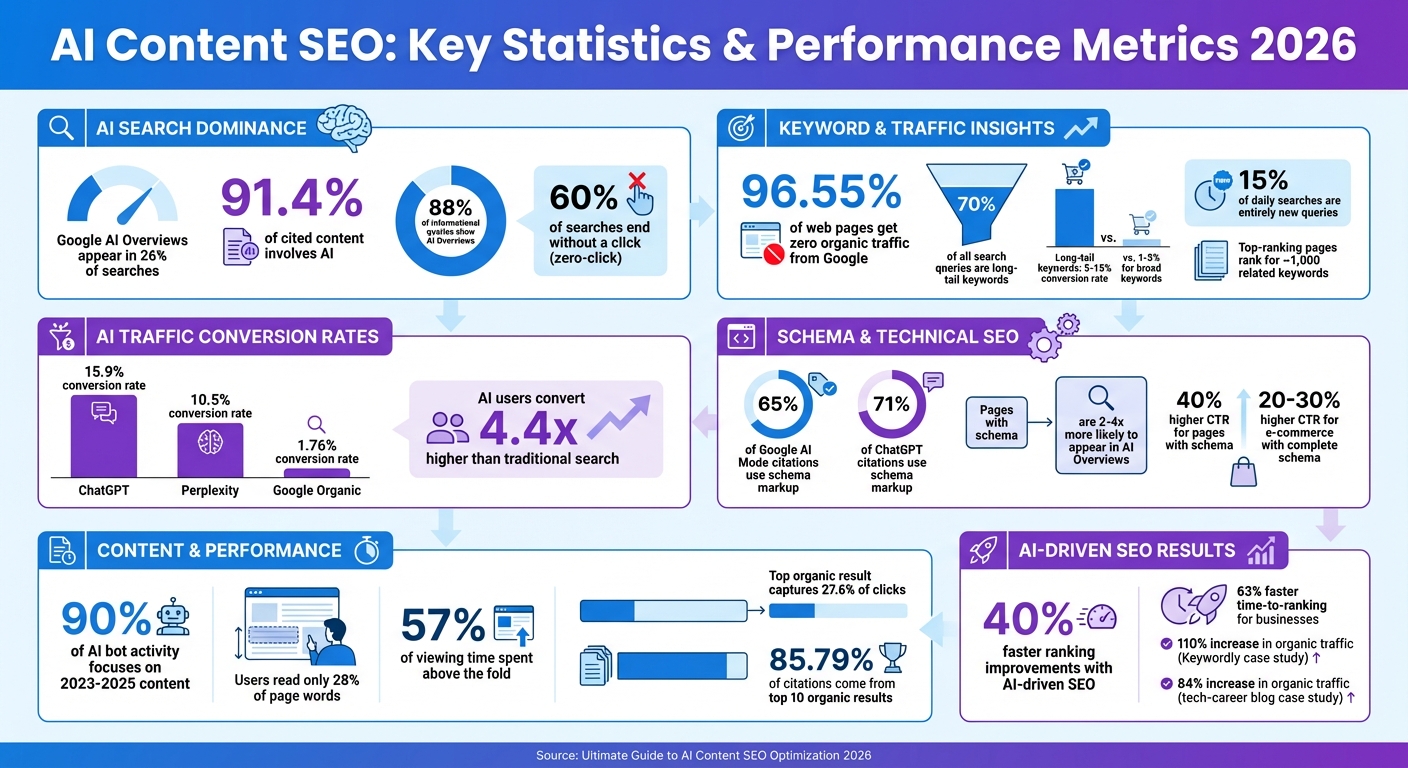
- AI-driven search is dominant: Google AI Overviews appear in 26% of searches, and 91.4% of cited content involves AI.
- SEO for career success: Optimizing resumes, portfolios, and LinkedIn articles for AI tools like ChatGPT and Google AI is critical for standing out to recruiters.
- Long-tail keywords matter: These capture specific user intent and align with conversational AI queries.
- Topical authority is key: Content should demonstrate expertise by covering topics comprehensively and using semantic clusters.
- On-page SEO essentials: Titles, meta descriptions, headers, and internal links must be optimized for both readability and AI extractability.
- Structured data is a must: Schema markup increases your chances of being cited by AI systems and improves visibility.
- Regular updates win: AI prioritizes fresh, accurate, and well-structured content.
Takeaway: To stay ahead, focus on making your content easy to find, extract, and trust - for both humans and AI. This guide dives into practical steps to help you rank higher and position yourself as an expert in your field.
AI Content SEO Statistics and Performance Metrics 2026
Keyword Research for AI Content
Keyword research has become more nuanced than ever. It’s no longer about cramming terms into your content but understanding how people interact with AI tools and search engines. The stakes are high: 96.55% of web pages get zero organic traffic from Google, often because they target the wrong keywords. Whether you're crafting a portfolio or building thought leadership, picking the right keywords can determine if AI systems cite you - or if you're overlooked.
Choosing Primary Keywords
A strong primary keyword checks three boxes: search volume (how many people are searching), keyword difficulty (how hard it is to rank), and search intent (does the query match what you offer). This is where the Keyword Value Triangle comes into play, helping you balance these factors. Start by identifying the problems your audience or potential clients are trying to solve, and use their natural language to guide your choices.
For instance, instead of aiming for a broad term like "project manager", which is fiercely competitive, go for something like "Agile project manager for fintech startups." This approach narrows the field and highlights your expertise.
Greg Gifford, VP of Search at Search Lab, explains: "The biggest mistake I see people making with keyword research is simply not doing it... Now that Google has evolved and is providing search results based on the intent of the search query, keyword research is more important than ever."
Use tools like Google Search Console to uncover "Hidden Gems" - keywords where you rank in positions 8–25. By optimizing these pages, you can push them onto the first page. Additionally, analyze prompts people use in AI tools like ChatGPT to better understand how they frame questions in your field.
Jonathan Berthold, VP of Revenue at Moz, adds: "Search volume isn't the only guiding light... Prompt tracking is about understanding how your audience thinks, asks questions, and explores problems in their own words."
Search engines now prioritize topical authority over keyword repetition. Content needs to show Experience, Expertise, Authoritativeness, and Trustworthiness (E-E-A-T) to stand out. Assign just one primary keyword per page to avoid "keyword cannibalization", where multiple pages compete against each other.
| Intent Type | Query Signals | Content Format |
|---|---|---|
| Informational | how, what, why, guide, tutorial | Educational articles, guides, videos |
| Commercial | best, vs, review, compare, top | Comparisons, roundups, reviews |
| Transactional | buy, sign up, download, pricing | Product pages, landing pages |
| Navigational | brand names, login, official | Brand homepage, login pages |
Once you’ve nailed your primary keyword, it’s time to focus on more specific queries using long-tail keywords.
Using Long-Tail Keywords
Long-tail keywords - those longer, more specific search phrases - are gold for AI-generated content. These keywords make up 70% of all search queries and have conversion rates between 5% and 15%, far outpacing the 1% to 2% conversion rates of broad keywords. They are particularly effective because they mirror the conversational tone people use with AI tools like ChatGPT and Gemini.
Take this example: "CRM" is a broad, highly competitive keyword. On the other hand, "Best CRM for small real estate business" is a long-tail keyword that captures specific user intent and attracts qualified traffic with less competition. Pages that cover a topic comprehensively using multiple related long-tail keywords rank 3.5x higher on average than those targeting a single keyword.
To prioritize long-tail opportunities, use the Keyword Golden Ratio (KGR): divide the number of "allintitle" results by the monthly search volume. If the result is 0.25 or less, you’ve found a keyword with high potential for quicker rankings. You can also mine internal chatbot logs or support tickets to discover the exact phrases your audience uses. Structuring your content so that each section answers a specific query can help AI tools extract and surface your content more effectively.
With the rise of voice search, queries are becoming longer and more conversational, averaging 4–6 words. This makes long-tail optimization essential for voice discovery. Businesses that focus on long-tail strategies report 47% lower cost-per-acquisition and generate 3.2 times higher ROI from organic traffic compared to those targeting broad terms.
Long-tail keywords also set the stage for building semantic clusters that establish expertise and authority.
Semantic Keywords and Topic Clusters
Search engines now prioritize topical authority over matching individual keywords. This means mapping out entire semantic networks - groups of related terms, synonyms, and contextually linked phrases - to signal depth and expertise. Using LSI (Latent Semantic Indexing) keywords helps search algorithms understand the context and relevance of your content.
Keyword clustering organizes terms by meaning and intent rather than just similarity. For example, "email marketing software" and "newsletter automation" belong in the same cluster because they target the same goal. The top-ranking pages typically rank in the top 10 for nearly 1,000 related keywords, which is only achievable through comprehensive topic coverage.
Aim to build clusters with 3–8 closely related terms per topic to stay focused without diluting your message. Create pillar pages that act as central hubs, with supporting articles linking back to them. This strategy distributes "link equity" and signals importance to search crawlers. Use the Golden Answer Format - a concise, 40-word response placed directly under H2 headings - to increase your chances of being cited in AI-generated summaries.
Keywordly implemented a strategy that turned seed keywords into 10 topical clusters (42 prioritized keywords). Over 90 days, they saw a 110% increase in organic traffic and improved their median ranking position from 32 to 12.
Similarly, a tech-career blog used 527 raw keywords to create 12 high-impact clusters. By publishing a pillar page titled "The Ultimate AI Resume Builder Guide" and linking it to 12 supporting articles, they achieved an 84% increase in organic traffic and ranked on the first page for 9 primary keywords.
Roughly 15% of daily searches are entirely new queries with no historical data. This underscores the importance of understanding emerging topics and providing unique insights. For your AI-generated content to stand out, it must deliver "information gain" - offering value or original research not found in competing content.
sbb-itb-6487feb
On-Page SEO for AI-Generated Content
Once you've nailed your keywords and clusters, the next step is optimizing your page elements. On-page SEO focuses on fine-tuning elements like titles, headers, formatting, and links to ensure your AI-generated content performs well. This approach not only aligns with search engine requirements but also helps AI tools understand your content better.
Writing Titles and Meta Descriptions
Your title tag is the first thing signaling your page's focus. With AI-driven search tools like ChatGPT and Perplexity, it's crucial to front-load your primary topic or solution. This ensures these tools quickly grasp what your content is about.
For instance, instead of a vague title like "10X Your Results", opt for something specific like "Sales Automation: Pipeline Management for B2B SaaS." A format like this - [Primary Entity]: [Action/Outcome] for [Audience] - clearly communicates the problem you're solving. Titles like this can increase click-through rates by up to 57%. Adding context, such as "[2026 Guide]" or "(Free Template)", can make them even more effective.
- Title length: Stick to 50–60 characters (around 600 pixels) to avoid truncation.
- Meta descriptions: Aim for 120–160 characters. Clearly state the value you offer and include a subtle call to action. Skip filler phrases like "In this article, you will learn..." and get straight to the point.
Liam Dunne, Growth Marketer at Discovered Labs, explains: "AI search engines use metadata as a retrieval filter before processing your full page content. When your title tag reads '10X Your Results' instead of 'Marketing Automation Platform,' LLMs skip your content entirely."
Here's why this matters: 60% of searches now result in "zero-click" outcomes, where users get answers from AI snippets instead of visiting your site. Google rewrites meta descriptions about 70% of the time if they don't align with user intent. Interestingly, AI-referred traffic converts at higher rates - 15.9% for ChatGPT and 10.5% for Perplexity - compared to just 1.76% for Google Organic.
Platforms like JobLogr demonstrate how AI-driven strategies can amplify content performance, leveraging these on-page SEO techniques.
| Page Type | Reliable Title Tag Formula | Example |
|---|---|---|
| Informational Guide | Primary Topic + Outcome + Year | On-Page SEO: Titles and Metas for 2026 |
| Service Page | Service + Qualifier + Market | Technical SEO Audit for B2B Sites (US & EU) |
| Comparison | Best + Category + Criteria | Best CRM Software: 2026 Comparison & Reviews |
| How-to | Action + Entity + Context | How to Write Title Tags for AI Summaries |
Structuring Content for Readability
To make your content easy for both users and AI to process, structure it into clear sections with H2 and H3 headers. AI tools scan for well-defined "semantic chunks" rather than reading word-for-word. Using headers effectively helps these tools understand your page's focus and relationships between topics.
Start each section with a concise statement using the BLUF (Bottom Line Up Front) method. This approach not only improves readability but also increases the chances of your content being featured in AI-generated summaries. Formatting headers as full questions (e.g., "What is AI Content SEO?") aligns with the conversational queries users often input.
- Generative AI queries now average 23 words, compared to just 4 words in traditional search.
- Research shows users typically read only about 28% of a page's words.
Ensure your main headline, key value proposition, and call to action are visible above the fold, where users spend about 57% of their viewing time.
A great example is Hostie AI, which applied Generative Engine Optimization techniques between January and March 2025. Within 60 days, they saw a 33.9% increase in brand mention rate and a 19.4% improvement in their average AI search ranking.
Internal Linking Strategies
Once your titles and structure are solid, internal links are the next step. These links guide readers and help search engines and AI crawlers understand your content's layout. Using a hub-and-spoke model - where a central "pillar" page links to related subpages - builds topical authority and makes it easier for AI tools to connect the dots.
To boost rankings, link high-authority pages to newer content. For example, the top organic search result captures 27.6% of all clicks. When adding links, use descriptive anchor text with your target keyword. Instead of "Read more here", use something like "Learn how to optimize AI content for search engines."
Ryan Law, Director of Content Marketing at Ahrefs, notes: "Internal linking helps search engines and AI crawlers find all the pages on your website, understand what each page is about (and how they relate to one another), and highlight the pages you believe to be the most important."
Interestingly, around 90% of AI bot activity focuses on content published or updated between 2023 and 2025. Keeping your information current ensures relevance and visibility.
Advanced SEO Techniques for AI Content
Once your on-page SEO is solid, it’s time to focus on technical optimization to make your AI-generated content accessible to AI systems. Search has shifted from ranking links to powering AI-driven answers. For instance, Google AI Overviews now appear in 88% of informational queries, and 60% of searches end without a click [42,44].
Matching Search Intent
Understanding user intent has grown more nuanced. Modern search intent includes three layers: Task Intent (what users aim to achieve), Format Intent (how they prefer the information - like a table or checklist), and Context Intent (specific factors like budget, location, or device).
AI users often phrase their queries differently than traditional searchers. To cater to this, your content should adopt a conversational tone. For example, instead of targeting "best CRM software", try addressing queries like "what's the best CRM software for a 10-person sales team with a $500/month budget."
Why does this matter? Visitors from large language models like ChatGPT convert at 4.4 times the rate of traditional search traffic. ChatGPT alone boasts a 16% conversion rate, compared to just 1.8% for Google Organic [44,46]. To tap into this, structure your content using the inverted pyramid approach - place the most critical, constraint-based answers at the top of your page [45,46]. AI systems favor concise, extractable elements like definitions, tables, and step-by-step guides.
Burim Bekteshi, Senior SEO Strategist, notes: "A traditional SEO audit is now obsolete. Checking your keyword density, title tags, and backlink profile is like checking a ship's rigging in the age of rocket engines. It misses the entire point."
To boost snippet eligibility, include a short, 40–60 word answer block near the top of your page [43,47]. Keep in mind, when Google AI Overviews appear, the first organic listing loses an average of 34.5% of its clicks [44,47]. However, 85.79% of citations still come from the top 10 organic results.
| Intent Layer | Focus Area | AI Optimization Tactic |
|---|---|---|
| Task Intent | User's ultimate goal | Map content to "Jobs to be Done" frameworks |
| Format Intent | Answer structure | Use tables, checklists, and step-by-step guides [46,6] |
| Context Intent | User constraints | Include specifics like pricing, location, and specs |
Next, let’s look at how schema markup can improve your content’s discoverability.
Adding Schema Markup and Metadata
Schema markup is structured code that helps search engines and AI systems interpret your content clearly. By 2026, 65% of pages cited by Google's AI Mode and 71% of pages cited by ChatGPT are expected to include schema markup. Pages with schema are 2 to 4 times more likely to appear in AI Overviews and featured snippets.
To get started, use JSON-LD in your HTML head for key schemas like Organization, Article, and FAQPage. These schemas make your content easier for AI to extract and can improve click-through rates [49,50,51,53].
Emily Carter, Senior Content Team Lead at WebFX, explains: "Structured data helps AI systems parse, validate, trust, and surface your content. By prioritizing structured data for AI citations, you make it easier for models to resolve entities, verify authorship, and attribute summaries back to your brand."
Focus on Entity Depth, which involves creating nested structures that build a knowledge graph for AI systems. For instance, you could nest Product → Manufacturer → Organization → Founder → Person. Use the sameAs property to link entities to trusted sources like Wikipedia, LinkedIn, or official registries [48,54]. This approach reduces AI errors, often referred to as "hallucinations", by grounding your content in verifiable data.
Schema markup doesn’t just help with AI. Pages with schema see a 40% higher click-through rate, and e-commerce products with complete schema enjoy 20% to 30% higher CTR compared to plain listings [50,51]. Use tools like Google’s Rich Results Test and monitor the "Enhancements" report in Google Search Console weekly to catch errors [50,53]. Ensure every schema property corresponds to visible content on your page - otherwise, it might be flagged as "Spammy Structured Data" [50,53].
Running Content Audits
While technical tweaks improve extractability, regular audits ensure your content stays relevant and authoritative. AI bots prioritize fresh content, with nearly 90% of their activity focused on pages published or updated between 2023 and 2025. If rankings drop for two consecutive quarters, it’s time to refresh that content [57,1].
Modern audits should go beyond keyword metrics and focus on E-E-A-T: Experience, Expertise, Authoritativeness, and Trustworthiness [55,56]. Start by reviewing your robots.txt file to ensure you’re not blocking essential AI crawlers like OAI-SearchBot, ChatGPT-User, ClaudeBot, PerplexityBot, and Google-Extended [45,58].
Organize your content into four categories:
- Keep: High-performing, relevant pages
- Update: Content with outdated data or declining traffic
- Merge: Thin pages covering similar topics
- Remove: Low-value pages that waste crawl budget [56,59]
Currently, over 90% of web pages receive no traffic from Google.
Shripad Deskhmukh, Founder at LLMClicks.ai, warns: "If an AI agent cannot easily parse your pricing page or feature list, it will simply move to your competitor's site. You are no longer just optimizing for human readability. You must optimize for machine extractability."
Adopt a 30/60/90-day roadmap for your audit process. Start with a small set of URLs in the first 30 days to set goals and identify quick fixes. Expand the audit during days 31–60, implementing updates like meta refreshes. By days 61–90, scale the process to your entire content library and establish an ongoing audit routine. Test your content by asking an AI model to summarize it - if the model struggles or generates errors, refine your structure and headings.
AI Tools for SEO Optimization
When it comes to advanced SEO strategies, specialized AI tools can take your content and career branding to the next level. Instead of spending hours manually tweaking resumes and cover letters, modern platforms use machine learning to identify key recruiter terms and optimize your materials. The best part? These tools don’t just save time - they deliver results. For instance, job seekers using AI tools are 53% more likely to receive a job offer and apply to 41% more jobs on average. These platforms are changing the game, blending efficiency with improved online visibility.
Using JobLogr for SEO-Optimized Content
JobLogr offers a thorough approach to personal branding. Think of its Resume Analyzer as an SEO audit for your career materials. It scans for missing keywords, weak points in messaging, and places where you can highlight high-impact skills. Upload your resume, and the AI compares it to the job description you’re aiming for, flagging gaps that could cause Applicant Tracking Systems (ATS) to filter you out. This is critical since 75% of resumes are rejected by ATS software before they ever land in front of a recruiter.
JobLogr also works its magic on LinkedIn profiles, suggesting updates that recruiters are more likely to notice. For $20 per month, the platform includes features like automated application tracking, cover letter creation, and Interview IQ - a tool that crafts tailored practice questions based on your resume and the role you’re targeting. Its Market Intelligence feature provides real-time insights on trending skills and salary benchmarks, helping you align your personal brand with current hiring trends. Users report saving up to 15 hours a week on job search tasks and finding jobs 3.3 times faster than with traditional methods.
"JobLogr is truly a groundbreaking tool for job searching and career exploration. From the Resume Analyzer to the Interview IQ, it provides genuine insight tailored to your resume."
– Alisa Hill, Director of Business Strategy and Operations
But JobLogr isn’t the only player in the AI-driven SEO space. Other tools focus on broader keyword and analytics optimization.
AI Tools for Keywords and Analytics
While JobLogr zeroes in on personal branding, tools like Keywordly and Semrush help boost content visibility across search engines. Keywordly (starting at $39/month) uses its "Answer The People" feature to pull data from Google’s "People Also Ask" sections and autocomplete suggestions. In 2025, HubSpot integrated Keywordly into their workflows and saw a 42% increase in organic search-driven leads.
Semrush, with its database of over 27 billion keywords, now includes "AI Visibility" tools that show how large language models (LLMs) feature your content. For those looking at both traditional search and AI chatbot visibility, Clearscope (starting at $170/month) tracks which sources LLMs pull from when generating responses.
For job seekers, Keyword Grid (starting at $78/month) focuses on analyzing content relevance. Its AI ensures your materials align with search engine priorities. As founder Adam Clarke explains:
"Most SEO tools guess at what works. I wanted something that actually shows you what search engines see - so I built Keyword Grid on the same AI models they use."
Tracking SEO Performance in Real-Time
Keeping tabs on your content’s performance means using tools that provide regular updates and actionable insights. Content Raptor ($47 per site per month) identifies "quick wins" by spotting pages ranking on the second or third page of search results and suggesting minor tweaks to push them higher. Rankable offers a free plan for up to four posts per month, while its Pro plan ($49/month) provides unlimited content analysis. It breaks down top-performing pages and helps replicate their success.
"Rankable is like having a full content team working 24/7 - but for a fraction of the cost."
– Sarah Kim, Head of Marketing at FlowMetrics
For job seekers, performance tracking involves monitoring application responses and interview requests. JobLogr’s free application tracking system logs every submission and identifies which resume versions yield the best results. Its analytics reveal that candidates who tailor keywords to specific roles experience a 30–40% higher response rate. One standout example: a Data Analyst improved their ATS score from 62% to 91% and landed an interview within 48 hours.
Conclusion
Optimizing AI-generated content for SEO isn’t just about better rankings - it’s about becoming the go-to source that AI assistants rely on to showcase your expertise. By 2026, your personal brand must shine across traditional Google searches, AI-driven summaries, and conversational AI platforms. The shift from focusing on "strings" (keywords) to "things" (entities) means recruiters and hiring managers are now discovering talent through multiple channels.
The strategies discussed here - like breaking down content into extractable pieces, using Trust Blocks, and keeping your material up-to-date - can make a noticeable difference. Websites that adopt AI-driven SEO strategies see ranking improvements 40% faster than those using manual methods, with businesses achieving a 63% faster time-to-ranking. For job seekers, this means getting in front of the right people much more quickly.
These approaches aren’t just theoretical - they’re steps you can start applying today.
"AI has changed content from a 'write → rank → convert' loop into a distributed retrieval problem: your content has to satisfy human intent and be legible, extractable, and trustworthy for AI ranking and answer systems."
– Kevin Fincel, Founder, Geol.ai
The key to staying ahead lies in refreshing your content regularly while maintaining accuracy. With 60–69% of all Google searches in 2025 expected to end without a single click, the focus shifts to earning citation share. This ensures your content is recognized as the authoritative source, even if it doesn’t directly drive traffic. Apply these methods to your professional materials, making sure they’re easy for both humans and AI systems to understand and recommend.
FAQs
How do I optimize content for AI Overviews and zero-click searches?
To improve visibility in AI Overviews and zero-click searches, start each section with a concise, straightforward answer to the query. Use headings framed as questions that mirror common search phrases. Include structured data formats like FAQ, HowTo, and Article schemas to help AI systems understand your content better. Build authority by creating detailed content clusters around specific topics, ensuring they cover all angles. Keep your content up-to-date and reference reliable sources, as AI favors accuracy and timeliness.
What’s the fastest way to build topical authority with topic clusters?
The fastest way to establish topical authority is by developing a well-organized content strategy centered around topic clusters. Begin with a pillar page that covers a broad subject in depth. Then, create 8-12 (or more) detailed articles focusing on related subtopics.
Make sure to include strategic internal links that connect these articles back to the pillar page and to each other. This setup signals expertise to search engines and AI systems, helping your content stand out. To keep your authority strong, plan subtopics ahead of time and regularly update your content to stay current and relevant.
Which schema markup should I add first for AI-friendly SEO?
To make your SEO more appealing to AI, start with Entity Depth schema. This involves creating detailed, nested structures, such as Product → Manufacturer → Organization → Founder → Person. These layers help AI grasp the context and verify your content more effectively.
Beyond that, using schema types like FAQPage, HowTo, and nested Course schemas can make your content easier for AI to process. These schemas not only improve understanding but can also boost your content's visibility in search results.