How AI Powers Real-Time Job Recommendations
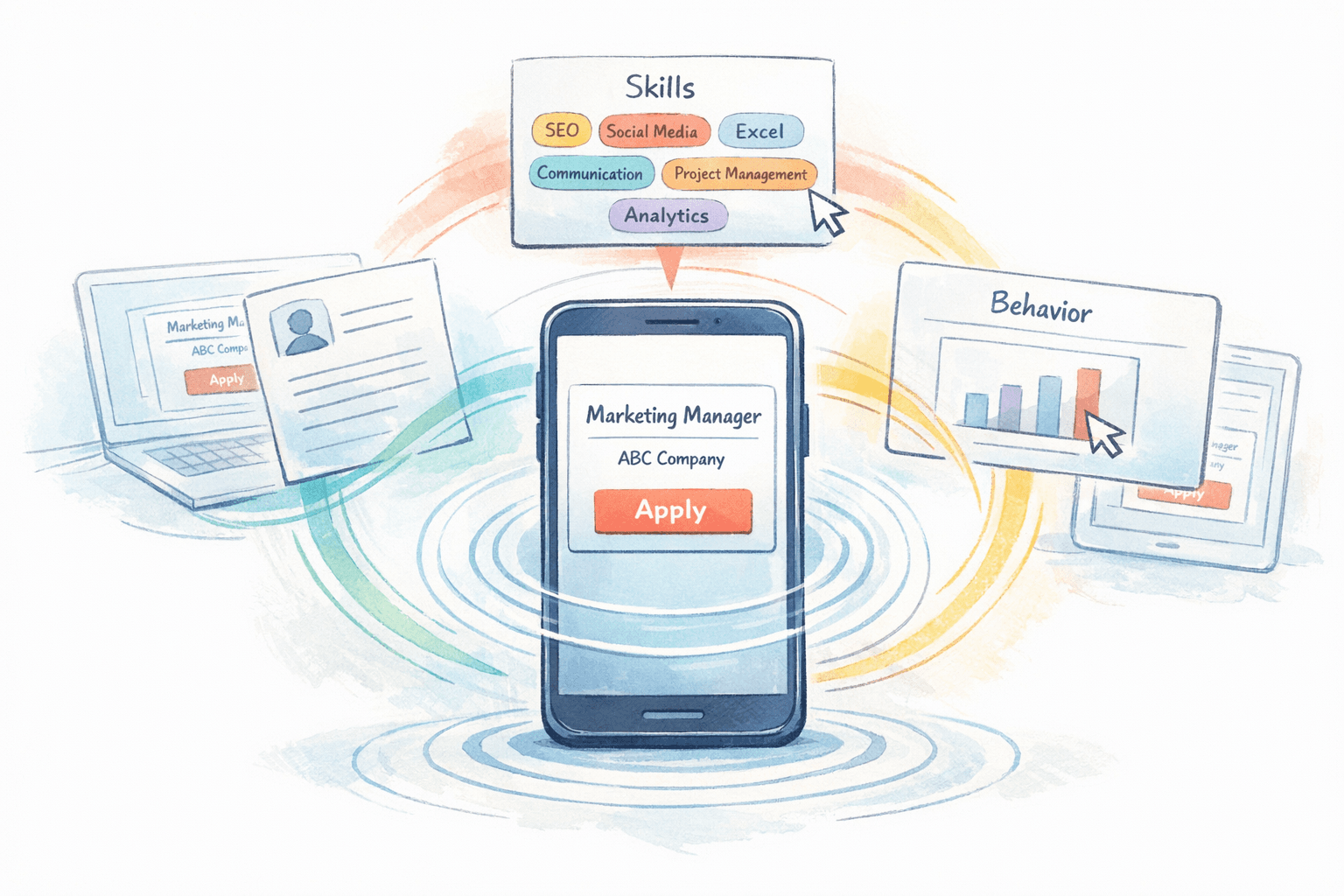
AI has transformed how job seekers find opportunities by delivering personalized, real-time job recommendations. Instead of manually searching through listings, AI tools analyze your resume, skills, and behavior to match you with relevant roles in seconds. These systems also monitor job boards like LinkedIn and Indeed every 15 minutes, ensuring you never miss an opportunity.
Key takeaways:
- Faster job matching: AI reduces job search time from 10+ hours to less than 1 hour per week.
- Higher success rates: AI-optimized searches increase interview rates by up to 70%.
- Precise recommendations: Tools analyze your career history, goals, and actions to suggest tailored roles.
- Real-time updates: Platforms like LinkedIn and ZipRecruiter refresh recommendations within minutes.
- Advanced tech: NLP, machine learning, and real-time data pipelines power these systems.
AI doesn’t just save time - it increases your chances of landing a job by aligning your profile with employer needs instantly.
Optimizing Your CV for LinkedIn’s New AI Matching
sbb-itb-6487feb
Core Technologies Behind AI-Driven Job Recommendations
The technologies powering AI-driven job recommendations ensure that matches are not just fast but also highly relevant. These systems go beyond simple keyword scanning - they understand context, predict intent, and adapt to user behavior to align with your career aspirations.
Machine Learning for Skill Mapping and User Profiling
Machine learning revolutionizes how resumes are analyzed, often outperforming human recruiters in efficiency. Tools like Natural Language Processing (NLP) libraries, such as Spacy, use Named Entity Recognition (NER) to extract key details like skills, experience, and education from unstructured text. Large language models take this further by identifying relationships between skills. For instance, if your resume mentions "Python" and "TensorFlow", the AI might suggest roles like "ML Engineer", even if that specific title isn’t explicitly listed.
A key innovation is detecting a candidate's current intent. LinkedIn engineers found that static profile data often fails to capture career shifts. To address this, they introduced "activity embeddings" - dense vectors summarizing recent actions like applying for or saving jobs. In May 2022, LinkedIn’s "Jobs You May Be Interested In" team used CNN sequence models to analyze the last 32 user actions. This led to a 10% rise in job applications and a 5% increase in confirmed hires during A/B testing. By prioritizing recent behavior through geometrically-decaying averages, the system ensures recommendations reflect where you’re headed rather than just where you’ve been.
Collaborative Filtering and Behavioral Analysis
Collaborative filtering focuses on user behavior, analyzing patterns among similar users to recommend jobs. This approach is especially useful for overcoming the "cold start" problem, where limited interaction history might otherwise hinder personalized results.
Behavioral analysis adds another layer by focusing on real-time actions. For example, in July 2020, LinkedIn’s AI Software Engineer Konstantin Salomatin introduced the Qualified Applicant model, which personalized recommendations by incorporating both individual and job-specific signals. This model increased the Area Under the ROC Curve (AUC) by 27% and drove significant gains in recruiter interactions, such as resume downloads. However, personalized models require fresh data to stay effective - without updates, their performance can drop by 50% within three weeks.
"Understanding and utilizing a member's job-seeking activity on the LinkedIn platform is crucial to making relevant recommendations... especially when a member is looking for a career trajectory change that cannot be captured using profile data."
– Alex T., Machine Learning Engineer, LinkedIn
While collaborative filtering leverages user behavior, content-based methods ensure precise matches by focusing on job-specific details.
Content-Based Similarity for Job Matching
Content-based filtering compares job descriptions with user profiles using techniques like cosine similarity and matrix factorization. More advanced systems employ BERT (Bidirectional Encoder Representations from Transformers) to create embeddings for both resumes and job descriptions, placing them in a shared semantic space. This allows the AI to differentiate nuanced terms - for example, understanding that "Agile" in software development means something entirely different than "Agile" in marketing.
Indeed Engineering has further refined its recommendation engine, enabling updates as frequently as every 15 minutes. This ensures that recommendations stay aligned with current market trends, significantly boosting user engagement. These technologies collectively enable real-time, dynamic job matching that adapts to changing data.
How Real-Time Job Matching Works Through Data Processing
Instant job recommendations rely on a sophisticated real-time data infrastructure that transforms raw inputs into personalized matches in just seconds. These systems juggle billions of data points daily - everything from new job postings to user profile updates - while delivering the speed and precision job seekers expect.
Stream Processing and Low-Latency APIs
Real-time job matching uses stream processing architectures that handle data as it flows through the system, instead of waiting for batch updates. Rather than refreshing recommendations once a day, modern platforms leverage tools like Kafka and Spark Structured Streaming to process updates almost instantly.
In November 2022, ZipRecruiter’s engineering team shifted from daily snapshots to a real-time pipeline powered by DynamoDB Streams, AWS MSK (Kafka), and Spark Streaming. This setup processes a massive "Jobs" dataset, which includes 20 billion historical and current job versions (over 100 TB), ensuring that new postings update matching models within an hour. As their team noted, "In hiring, every minute counts".
Key technologies like Redis and Kafka play a critical role by offloading demanding AI tasks to background workers (like Celery), preventing the main API from freezing. Micro-batching further optimizes performance, processing data in tiny increments - sometimes as frequently as every 5 seconds - to balance real-time results with system efficiency. To keep latency low, platforms often use vector similarity search methods like K-Nearest Neighbors (KNN). Advanced databases, such as Redis 8, can rank thousands of semantically relevant jobs in mere milliseconds.
For a better user experience, platforms use Server-Sent Events (SSE) to send live progress updates - like "Analyzing job description" or "Evaluating skills" - directly to users over a single HTTP connection. Anurag Kumar from Senseloaf.ai highlights the benefits of SSE: "It's simpler to implement than WebSockets, works over standard HTTP, and has built-in support in browsers".
These rapid processing methods also enable platforms to seamlessly integrate updates from job boards and user activity.
Dynamic Updates from Job Boards and User Actions
Real-time systems continuously adapt by incorporating live user actions and updates from job boards. On the user side, platforms monitor profile changes (skills, experience, location), resume edits, and real-time behaviors like job applications or dismissals. On the job side, they integrate live data such as new postings, updates to descriptions, deletions, and changes to metadata like salary ranges or required skills.
In May 2025, LinkedIn launched its JUDE (Job Understanding Data Expert) platform, a system powered by fine-tuned 7B LLMs that generate embeddings for over 1 billion users and millions of job listings. Using a Kappa architecture with Samza processing pipelines, JUDE ensures that profile and job features reflect their most current state. By employing hashing-based change detection, LinkedIn reduced AI inference loads by about six times, re-processing only when significant text changes occur. This optimization led to a 2.07% increase in qualified applications and a 1.91% rise in total job applications.
The system also tracks availability signals, such as when candidates mark themselves as "open to work" or leave a job, enabling immediate outreach. Additionally, it factors in social media activity and professional posts to capture interests and motivations that static profiles might miss. As Chris P. from Crustdata puts it, "The platforms that win are the ones that can act on fresh intelligence about job changes, contact updates, and hiring signals as they happen".
Cross-Platform Synchronization for Consistent Job Suggestions
Today’s job seekers often switch between devices - phones, laptops, tablets - when searching for opportunities. This makes it crucial for AI-powered systems to keep job recommendations aligned across all platforms. If a user dismisses a job on one device, it shouldn't resurface on another. Cross-device synchronization ensures that job suggestions remain personalized, up-to-date, and consistent no matter where users access them.
Integrating with APIs and External Platforms
AI systems rely heavily on API integrations and stream processing architectures to stay in sync with external job platforms. These systems pull updates from multiple sources in real time. For example, tools like Apache Samza or Kafka process new job postings or listing updates within seconds, ensuring users always see the latest opportunities.
A critical part of this process is the use of standardized action schemas. Every user interaction - whether it's clicking on a job, updating a skill, or submitting an application - is recorded in a consistent format (actor, verb, object). This uniformity allows multiple recommendation engines to access and process the same data simultaneously, whether it's for job suggestions, feed updates, or networking recommendations.
In March 2022, LinkedIn introduced a near real-time feature system powered by Apache Samza and Apache Pinot. This system captured user intent across devices, leading to a 0.66% increase in job applications and a 20% drop in dismissed recommendations. Rupesh Gupta from LinkedIn emphasized the importance of speed in this system, stating:
"The 100-millisecond latency constraint ensures that recommendations are served to a member within a few hundred milliseconds after the member lands on a page".
For platforms without public APIs, browser extensions and webhooks step in to extract updates and trigger instant workflow changes. These tools have proven effective, with browser extensions achieving 94% accuracy in extracting recruiter email updates from 5,000 test cases. Together, these integrations ensure synchronized and consistent job recommendations across all devices.
Synchronizing User Data Across Devices
Once data is ingested, the next challenge is to harmonize it across all devices a user might use. High-performance key-value stores like Venice and analytical databases such as Apache Pinot play a key role here. These systems maintain a single, instantly accessible data source, capable of processing over 20,000 queries per second.
Modern systems also use nearline inference pipelines to update AI embeddings as soon as user preferences or profiles change. Instead of relying on slower batch processes, Kappa architecture ensures that updates are reflected almost immediately. LinkedIn's advancements in this area have shown how real-time synchronization improves performance. For instance, research found that delaying the use of user actions from 1 minute to 24 hours could reduce a job recommender model’s effectiveness by 4.45%. Nikita Zhiltsov from LinkedIn explained:
"Nearline embeddings are published to key-value stores for fast access by our ranking models... implying that changes or creation of jobs, member profiles, and resumes are reflected almost real-time".
To manage costs and scalability, AI systems employ hash-based change detection. This method avoids redundant processing by skipping updates for unchanged job descriptions or profiles. LinkedIn has used this optimization to cut AI inference loads by about six times, while still increasing qualified applications by 2.07%.
How JobLogr Uses AI-Powered Job Recommendations
JobLogr uses advanced AI technology through its personal recruiter, JobRex. This tool scans over 100,000 career pages and gathers listings from major platforms like LinkedIn, Indeed, Glassdoor, and ZipRecruiter. By analyzing your resume, profile, and application history, JobRex generates a ranked list of job opportunities tailored to your skills and preferences. The system continuously learns from your job applications, refining its recommendations over time. This dynamic approach ensures that JobLogr provides job matches that align with your current qualifications and job market trends.
Key Features of JobLogr's AI-Powered Tools
JobLogr's AI tools are designed to streamline every step of your job search. One standout feature is the AI Resume Tailoring & Builder, which customizes your resume to match specific job descriptions. This increases the chances of passing Applicant Tracking Systems. The chat-based builder allows you to describe your experience, and the AI instantly generates a polished resume.
The AppTrackr dashboard simplifies organization by automatically tracking job details, deadlines, and application statuses - eliminating the need for manual input. Another time-saving tool is the AI Cover Letter Generator, which combines your resume details with job requirements. As Natalie G., a Marketing Manager, shared:
"It takes your resume skills and the job description and marries them seamlessly, which saved me TONS of time writing a professional cover letter".
For interview preparation, InterviewIQ predicts likely questions and suggests personalized talking points based on the job description and your background. Additional tools like HireWire and CareerInfluencer provide real-time insights on salary trends and in-demand skills, while LinkedIn Profile Optimization helps boost your visibility in recruiter searches. These features not only enhance your application materials but also improve your overall job search efficiency.
Benefits of Using JobLogr for Job Seekers
JobLogr delivers impressive results for job seekers. Users report getting hired 3.3 times faster, potentially reducing the typical 12-week job search to just 3 weeks. The platform increases the likelihood of receiving job offers by 53%, and users apply to 41% more jobs on average. By saving up to 15 hours per week on job-related tasks, JobLogr can help reduce lost wages by approximately $14,000 due to faster hiring. Additionally, personalized cover letters lead to 50% more interview requests, and AI-powered resume tools can boost interview rates by up to 70%.
Career coach Jenny Foss, Founder of JobJenny, highlighted her experience with the platform:
"I've been experimenting with JobLogr for weeks... and am seriously impressed... It's also priced extremely competitively".
JobLogr is fully mobile-friendly, accessible on both iOS and Android devices, and doesn’t require software downloads or browser extensions.
Subscription Plans and Pricing
JobLogr offers a 7-day free trial with limited access to its features. The Premium plan, priced at $20 per month, provides full access to tools like resume analysis, tailoring, cover letter generation, and interview preparation. Importantly, the AppTrackr feature is free to use indefinitely. At $20 per month, JobLogr is notably more affordable than similar platforms, which often charge between $36 and $49.95 monthly. Plus, the platform includes a money-back guarantee if it doesn’t improve your job search. This combination of affordability and powerful AI-driven features makes JobLogr a valuable resource for job seekers.
Measuring the Impact of AI on Job Recommendations
AI vs Traditional Job Search Methods: Performance Metrics Comparison
Key Metrics for Success
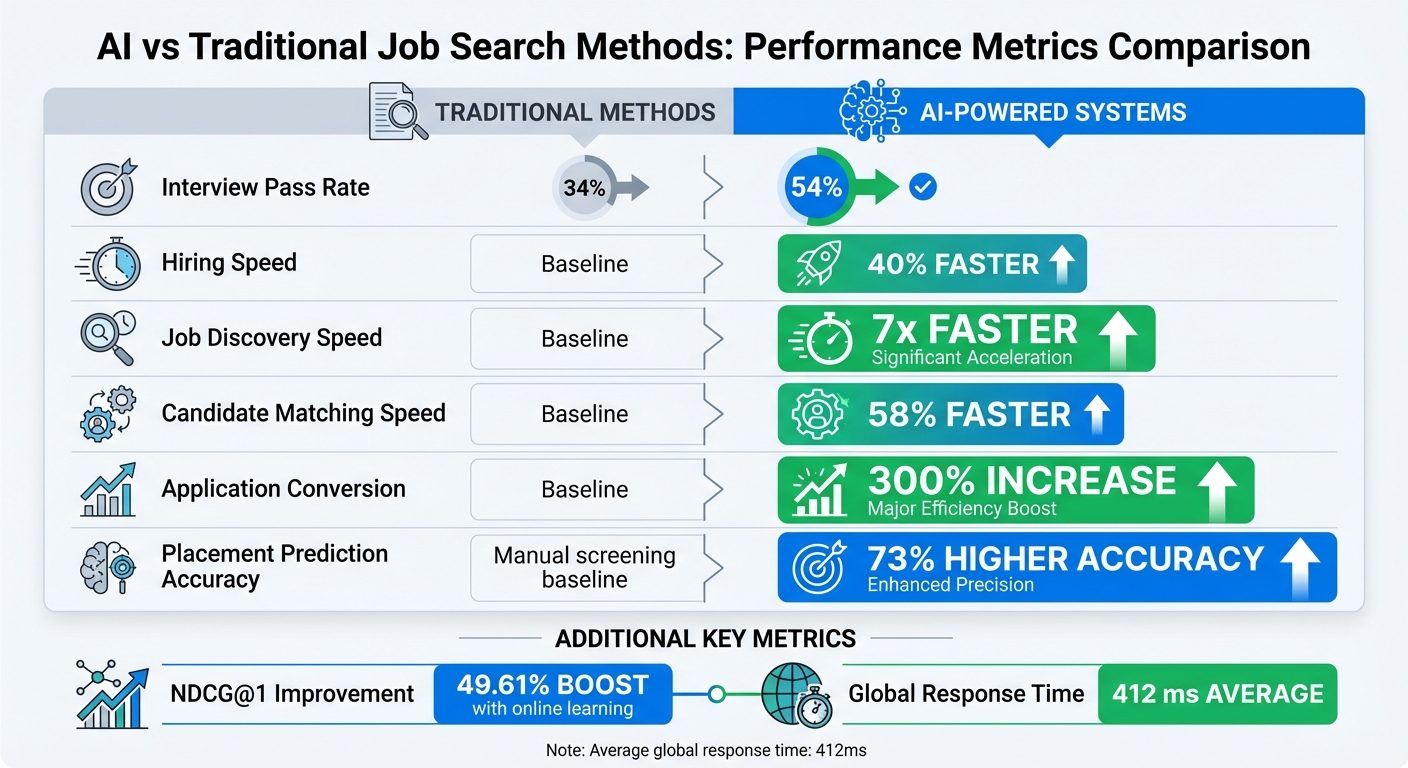
AI-powered job recommendation systems have brought measurable improvements in areas like speed, accuracy, and conversion rates, significantly outperforming traditional methods. Here's how they compare:
| Metric | Traditional Methods | AI-Powered Systems |
|---|---|---|
| Interview Pass Rate | 34% | 54% |
| Hiring Speed | Baseline | 40% faster |
| Job Discovery Speed | Baseline | 7x faster |
| Candidate Matching Speed | Baseline | 58% faster |
| Application Conversion | Baseline | 300% increase |
| Placement Prediction Accuracy | Manual screening baseline | 73% higher accuracy |
High-performing AI platforms maintain global response times averaging 412 milliseconds, ensuring users stay engaged. To measure recommendation accuracy, systems rely on metrics like Area Under the ROC Curve (AUC) and Normalized Discounted Cumulative Gain (NDCG). Personalized AI models have been shown to improve AUC, while online learning capabilities deliver a 49.61% boost in NDCG@1.
These performance metrics lay the groundwork for understanding how AI reshapes job recommendations in practical scenarios.
Real-Life Impact on Job Seekers
The technical advancements of AI translate into clear benefits for both companies and job seekers. For instance, in January 2026, BrightSpring Health Services leveraged Indeed's Talent Scout AI agent to fill 45% more hard-to-fill roles within four weeks. Additionally, their recruiting team saved eight hours weekly. Maggie Hulce, Indeed's Chief Revenue Officer, emphasized:
"AI is core to our mission of helping people get jobs. For nearly 20 years, we've used AI to power billions of connections between job seekers and employers".
This success underscores how cross-platform synchronization and real-time updates enhance recruitment outcomes.
Another standout example comes from JobKorea. After rolling out their AI Recommendation 3.0 system in May 2024, the platform saw a 300% jump in click-through rates and job applications within just 10 days. Similarly, a Swedish study involving 59 million recommendations found that AI-driven suggestions increased the likelihood of a worker being hired at a specific workplace by 5%, while job seekers experienced a 0.6% higher employment rate within six months.
Perhaps the most striking example is micro1's July 2025 field test with 37,000 applicants. Their AI interviewer, "Zara", achieved a 54% interview pass rate, compared to 34% with traditional methods. Five months later, 40% of AI-selected finalists had secured new jobs, outperforming the control group by 17 percentage points.
Conclusion
Key Takeaways
AI has reshaped the way job seekers find and apply for opportunities. Instead of manually browsing through countless job boards, AI-powered platforms now function like round-the-clock personal recruiters. These tools pull data from sources such as LinkedIn and Indeed, delivering ranked and customized job lists tailored to individual profiles. What's more, resumes are no longer static documents. They’ve evolved into dynamic assets that sync with live market data, helping candidates align more closely with what employers are looking for. This shift saves time and improves efficiency.
AI-driven tools have drastically reduced job search times - from over 10 hours to less than one hour - and increased interview rates by as much as 70%. Currently, about 75% of recruiters use AI in their hiring processes.
Platforms like JobLogr go a step further by offering centralized dashboards that not only track applications but also pinpoint skill gaps and provide tailored career resources. These resources are aligned with specific job descriptions, ensuring candidates are better prepared.
In short, AI streamlines and enhances the job search process. With real-time processing, cross-platform synchronization, and intelligent automation, it transforms job hunting into a more efficient and measurable experience.
FAQs
How does AI know what jobs I want right now?
AI figures out the types of jobs you're interested in by studying your behavior, preferences, and profile details in real time. Using tools like natural language processing (NLP) and machine learning, it evaluates actions such as which jobs you view, save, or skip, along with your application history. Platforms like JobLogr adjust recommendations on the fly, tailoring them to match your changing career goals and what you're currently looking for in a job.
How do job recommendations stay in sync across my phone and laptop?
AI-powered synchronization keeps your job recommendations current and consistent across all your devices. It works by automatically syncing your profiles, resumes, and application statuses in real time. This means any updates you make - like tweaking your resume on one device - are instantly reflected everywhere else. The result? A smoother job search experience and improved visibility to recruiters, thanks to accurate and unified information.
What can I do to improve the quality of AI job matches?
To get better job matches with AI-powered platforms, it's essential to share precise and detailed information about your skills, work experience, and job preferences. Regularly updating your profile ensures the system has the most current data to work with. Additionally, interacting with the platform - such as providing feedback on job matches and actively applying to roles that align with your interests - can fine-tune the recommendations.
Platforms like JobLogr take this a step further by using real-time learning and natural language processing. These tools analyze your activity and adjust their suggestions to better match your evolving preferences over time.