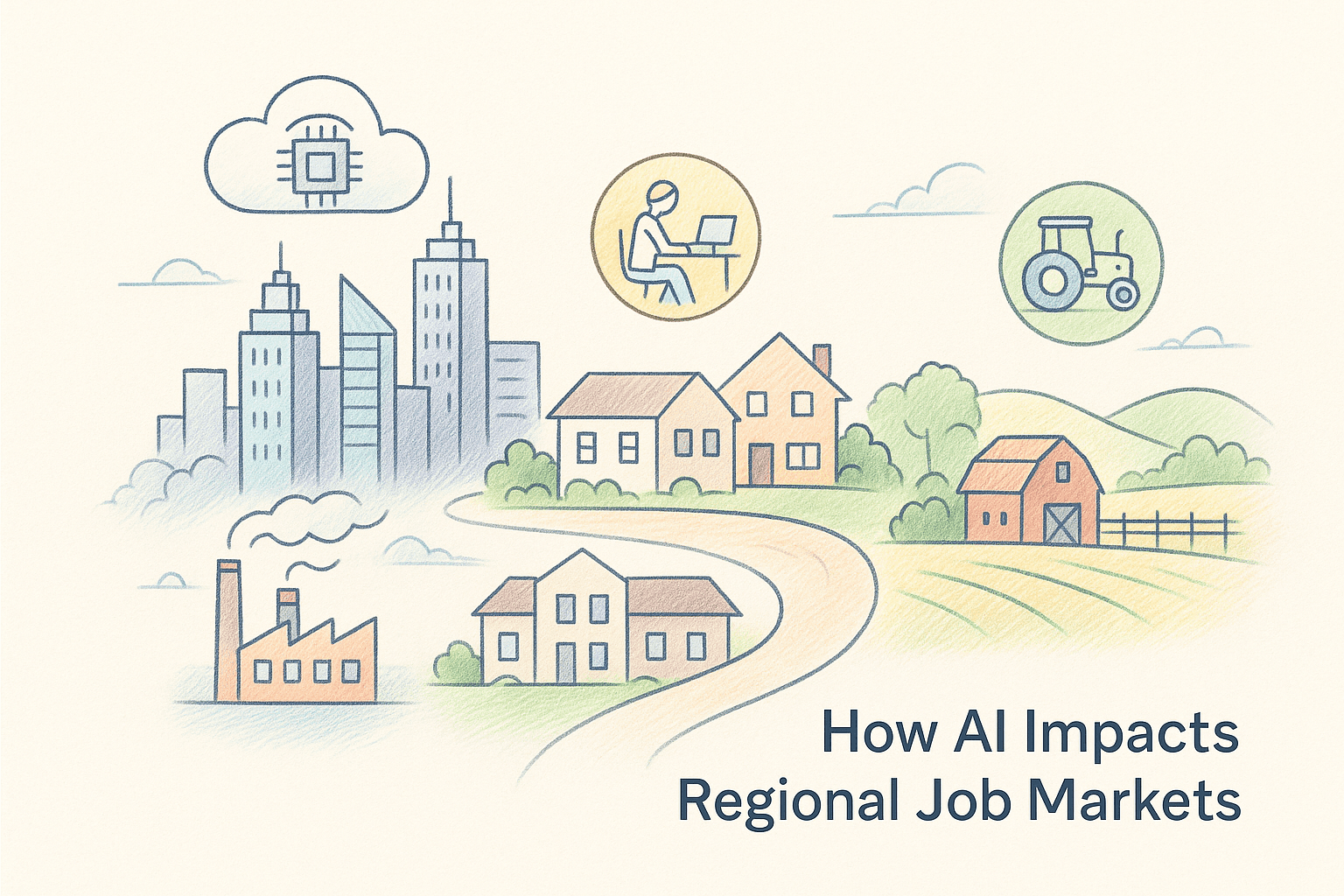
How AI Impacts Regional Job Markets
Artificial intelligence (AI) is reshaping the U.S. job market in uneven ways across regions, industries, and job types. Here's what you need to know:
- Urban areas like California, Texas, and New York are leading in AI job creation, with thousands of openings in software development, finance, and energy sectors.
- Rural areas remain less affected due to limited AI adoption, with stable employment in blue-collar and personal service roles.
- Job shifts: AI automates routine tasks (e.g., customer service, medical transcription) but creates high-paying roles like machine learning engineers (average salary: $150,000).
- Young workers face challenges, with a 6% employment drop in AI-exposed roles for 22–25-year-olds since 2022.
To thrive, focus on in-demand skills like Python, cloud computing, and data analysis. Use tools like JobLogr to optimize your job search, track trends, and tailor applications to AI-driven markets.
How AI Is Driving Labor Market Transformation - And What This Means For Employers
How AI Affects Employment in Different Regions

AI Job Market Impact by Region: Urban vs Suburban vs Rural Employment Trends
Regional Differences in AI Adoption and Job Changes
AI adoption isn't uniform across the United States; it varies significantly by region. Urban areas are at the forefront, thanks to advanced infrastructure and substantial tech investments. This has led to both the creation of new jobs and the elimination of others. For example, roles in AI development and software engineering are on the rise, but more routine jobs are shrinking. By 2033, customer service positions are expected to decline by 5.0%, while medical transcription jobs may see a 4.7% drop.
In suburban areas, AI adoption is moderate, with its impact spread across finance and business sectors. Insurance adjusters, for instance, are seeing a 4.4% decline as AI takes over damage assessments. On the flip side, financial advising roles are growing because they require nuanced human decision-making. Meanwhile, rural areas are largely insulated from AI disruption. Limited infrastructure and connectivity have kept adoption low, resulting in stable job markets. Jobs in blue-collar and personal service sectors, which are less exposed to AI, remain steady. Studies reveal only a 0.47 correlation between AI exposure and unemployment increases in rural areas from 2022 to 2025.
These regional disparities highlight the importance of understanding how AI adoption affects specific industries, helping job seekers adapt their career strategies.
Industries Most Changed by AI
The shifts in regional AI adoption closely align with changes in key industries. In the tech sector, entry-level programmers are facing challenges as AI takes over routine coding tasks. However, there's growing demand for engineers skilled in building and maintaining AI systems. In finance, roles like insurance appraisers are declining sharply - down 9.2% - as AI tools handle damage assessments and claims processing. Yet, positions requiring complex decision-making remain robust.
In manufacturing, AI systems are transforming production lines, shifting factory work from manual tasks to system oversight. Meanwhile, the healthcare industry is seeing a decline in medical transcription roles due to AI-driven documentation tools. However, nursing positions remain strong because they rely on human empathy and hands-on care - qualities AI cannot replicate. Fields like architecture and engineering are also benefiting from AI tools that enhance productivity, but job losses are minimal since regulatory requirements still necessitate human expertise and accountability.
Regions with Strong AI Job Growth
Certain states are emerging as leaders in AI-driven job creation, reflecting both regional and industry trends. California, Texas, and New York are at the forefront. California, powered by Silicon Valley, is a hub for AI research and development, creating thousands of software development roles. Its robust tech ecosystem and access to venture capital make it the nation's leader. Texas, on the other hand, is leveraging AI in energy technology, optimizing processes like oil extraction and renewable energy management. In New York, the finance sector is driving AI job growth, with applications in trading, risk assessment, and fraud detection creating specialized roles.
With 78% of organizations actively using AI in 2024, these urban centers are accelerating faster than other regions. According to McKinsey, AI could unlock $2.9 trillion in value by 2030 through redesigned workflows, with California, Texas, and New York poised to claim the largest share of this growth. Job postings requiring AI expertise have surged sevenfold, with the highest concentrations in these leading states.
How to Research AI Trends in Your Local Job Market
Using Labor Market Data to Track AI Trends
The Bureau of Labor Statistics (BLS) integrates AI's impact into its 10-year employment projections, making it a great resource for understanding how jobs in your area might evolve. Head over to bls.gov/data and explore the Occupational Employment and Wage Statistics (OEWS). You can filter by your city and job type to see projections through 2033. For example, certain roles in the insurance sector, like claims adjusters, are expected to decline.
Your state labor department can also provide valuable regional insights. Look for "Labor Market Information" on your state workforce agency's website - examples include California's EDD or the Texas Workforce Commission. These reports can highlight which industries are growing and how automation is influencing local employment. To get a clearer picture, check local job postings to identify the specific AI-related skills employers are currently seeking.
Finding AI-Related Skills in Demand Locally
Job postings are a goldmine for understanding what skills are in demand. Use platforms like Indeed, LinkedIn, or Google Jobs to filter by your city and search for terms like "AI", "machine learning", "data science", or "Python." For instance, data from Q1 2025 shows that AI-related job postings saw a 25.2% increase year-over-year, with a median salary of $156,998.
Keep track of job titles, skills, and salary ranges in a spreadsheet to identify patterns. You might notice that certain regions prioritize expertise in platforms like TensorFlow or cloud computing, while others lean more toward data analytics and SQL. Both technical and soft skills matter, so focus on the qualifications and certifications that show up most often in your local job postings.
Comparing Regional Job Markets
Once you've identified local trends and emerging skills, compare job markets across different regions to refine your career strategy. Create a table with columns for Region, AI Job Growth, Median Salary, Top Skills, and Unemployment Trends. For instance, while Silicon Valley might show a strong demand for software development roles tied to AI, certain Midwestern areas may focus on manufacturing jobs with slower AI adoption.
Combining insights from data and job postings will give you a well-rounded view of your local AI job market. Use BLS metro-area data to check unemployment rates and state labor websites for wage comparisons. Reports like Veritone's Q1 2025 analysis, which noted 35,445 AI-related jobs in the U.S., can also provide helpful context. This kind of comparison can show whether your region - or nearby areas - offers better growth potential. While urban tech hubs often lead in AI adoption, the pace of change can vary widely by location.
For more tailored guidance, you can explore AI-powered career tools like those on JobLogr. These tools can help you track market trends, refine your job search, and find opportunities in areas where AI is transforming the workforce.
sbb-itb-6487feb
Developing Skills for AI-Related Careers
Key Skills for AI-Related Roles
Starting a career in AI often begins with mastering Python, a programming language that appeared in 35,000 job postings in the first quarter of 2025 - a 25.2% increase from the previous year. For roles like Machine Learning Engineer, which come with a median salary of $156,998, you'll need expertise in cloud computing (think AWS or Azure), natural language processing (NLP), and the core principles of machine learning. But here's the thing: technical know-how isn’t enough. Employers also prioritize problem-solving and communication skills, as these are crucial for transforming AI technologies into real-world business outcomes.
In industries like finance and insurance, where roles such as claims adjusters are projected to decline by 4.4% by 2033, there's a growing need for professionals who can manage AI systems while maintaining strong client relationships and exercising sound judgment.
Another must-have skill? Data analysis. Whether you're eyeing tech hubs like California (with 3,633 AI job openings) or financial centers like New York (with 2,446 opportunities), employers are looking for candidates who can navigate SQL databases, build dashboards with tools like Tableau or Power BI, and interpret data to drive decisions. According to the Bureau of Labor Statistics, software development roles - critical for building and maintaining AI systems - are also expected to grow steadily through 2033.
The good news? Many of these skills can be learned through targeted training programs, both online and in your region.
Training Options in Your Region
Community colleges are a great starting point for affordable AI training. In states like California and Texas, where tech jobs are plentiful, these institutions have expanded their offerings in AI and data science - often at a fraction of the cost of a four-year degree. If you're looking for flexibility, online platforms like Google Career Certificates, Coursera, and edX offer specialized training programs for around $49 per month.
Some regions are also taking unique steps to connect training with local job markets. For example, Milwaukee's MKE Tech Hub has created AI training roadmaps tailored to the manufacturing sector, linking startups with workers in need of reskilling. Even in rural areas, where infrastructure can be a challenge, remote learning through AI-powered platforms enables access to the same certifications available in urban centers. In places like Sarasota County, Florida, job seekers can use these resources to stay competitive. Don’t forget to check your state workforce agency’s website for WIOA-eligible training providers, which often offer subsidized programs in areas like IT, data analytics, and cloud administration.
Using AI Tools for Skill Development
Once you've built a foundation of skills, AI-powered tools can help you refine and target your expertise. Take JobLogr's Resume Analyzer, for example. It compares your resume to job postings - whether you're aiming for a Machine Learning Engineer role in California or a Data Analyst position in Maryland (which boasts a 99.6 AI readiness score) - and identifies gaps in areas like Python, NLP, or cloud certifications. This kind of targeted feedback ensures you're focusing on the skills that matter most to employers in your area.
JobLogr also offers a resume tailoring feature that automatically adjusts your application materials to highlight relevant keywords such as "machine learning" and "cloud computing", helping you get past applicant tracking systems. Plus, with integrated interview preparation tools, you can practice explaining how you'd approach challenges with AI systems. According to JobLogr, users are 53% more likely to land job offers and apply to 41% more roles. By tracking which applications lead to callbacks, you can pinpoint the skills and certifications that truly make a difference in your local job market.
Adjusting Your Job Search Strategy with AI Tools
Using AI to Identify High-Growth Regions
The demand for AI-related jobs isn't evenly spread across the United States. In the first quarter of 2025, there were 35,445 AI-related job openings nationwide, marking a 25.2% increase from the previous year. Unsurprisingly, these opportunities are heavily concentrated in tech hubs like California and Texas. AI-powered platforms make it easier to locate these high-growth areas by analyzing real-time labor market data, such as job postings and median salaries, which reached an impressive $156,998 in Q1 2025.
For example, JobLogr ranks regions based on real-time labor market trends. If you're targeting machine learning positions, the platform might highlight the West Coast for AI architecture roles or the Southeast for engineering positions expected to expand through 2033. You can even set alerts for regions experiencing strong growth - like areas with an 8.8% quarterly increase in AI jobs - while steering clear of declining markets, such as insurance-related fields, where roles are shrinking by 9.2%.
Customizing Applications for AI Jobs
Once you've pinpointed promising regions, it's time to tailor your applications to meet local market demands. JobLogr's resume optimization feature analyzes job descriptions from specific areas and fine-tunes your resume to highlight the skills employers are actively seeking. For instance, if you're applying for a data scientist role in Texas, the tool might emphasize keywords like "GenAI productivity" or reference the 25.2% growth in regional AI jobs to showcase your understanding of local trends.
The platform also offers a cover letter generator that customizes your application to align with regional priorities. For example, it might craft a cover letter that mentions a company's adoption of GenAI and ties it to the 25.2% surge in AI job opportunities, demonstrating how your expertise in machine learning supports anticipated growth in engineering roles.
Monitoring and Refining Your Job Search
After tailoring your applications, it's important to track their performance and adjust your strategy as needed. AI tools like JobLogr not only streamline your application process but also provide insights to help you understand what’s working. The platform categorizes your applications and generates analytics to reveal trends. For example, if your response rates are low for insurance-related roles in the Midwest - where jobs are declining by 4.4% - JobLogr might recommend shifting your focus to software positions on the West Coast, where demand is much stronger.
With its dashboard, you can monitor key metrics like response rates, interview conversions, and skill gaps. These insights can reveal patterns, such as a 20% higher response rate in AI-focused regions, helping you refine your approach. The platform also highlights which certifications or skills lead to more interview opportunities, ensuring your job search strategy evolves with the market.
Conclusion
AI is reshaping the U.S. job landscape, but its impact varies widely across regions. Tech-heavy areas like California and Texas are experiencing strong AI-driven growth, while manufacturing-focused regions are adapting at a slower pace. Some jobs are shrinking, even as demand for roles in engineering and software development continues to rise. Staying informed about your local job market is more important than ever. By using resources like BLS data, you can pinpoint which roles are on the rise or decline and focus on building skills that align with AI's influence. For example, unemployment for college graduates in AI-heavy fields like computer engineering hit 5.8% in March 2025 - the highest in over four years - showing how crucial it is to adapt quickly.
AI-powered tools can be game-changers in navigating these shifts. Platforms like JobLogr help job seekers identify growth regions, tailor applications, and track progress. Users have reported landing offers 53% more often and applying to 41% more opportunities. These tools also save about 16 hours per week, freeing up time to focus on upskilling or targeting the best opportunities.
With 78% of companies now integrating AI into their operations, adaptability is key to standing out in the labor market. Businesses that adopt AI have seen 6% higher employment growth and a 9.5% boost in sales over five years. By combining solid market research, focused skill-building, and smart use of AI-driven job search tools, you can turn the challenges of an evolving workforce into opportunities for success.
FAQs
How can I find out which AI-related skills are in demand in my area?
To figure out which AI skills are most sought after in your area, take a close look at industry reports and keep an eye on local job market trends. Checking regional job boards and attending professional networking events can also give you a clearer picture of what employers are prioritizing.
You can simplify this process by using AI-powered tools like JobLogr. These platforms provide personalized recommendations based on up-to-date market data, helping you zero in on the skills that are currently in demand where you live.
How does AI adoption affect job opportunities in urban and rural areas?
AI adoption affects job markets in urban and rural areas in distinct ways. In cities, AI technologies tend to take root more quickly, opening up opportunities in fields like tech, finance, and healthcare. Urban workers often benefit from cutting-edge job-matching platforms, tailored applications, and an increasing number of remote work possibilities.
Meanwhile, rural areas experience a slower pace of AI integration. This often means fewer local job opportunities and limited access to AI-powered tools, making it harder for workers to tap into the advantages AI offers. These differences underline the need for strategies and resources that can help rural job seekers improve their job search and adapt to changing trends.
How is AI changing job prospects for young professionals starting their careers?
AI is transforming how young professionals approach their job search, making the process smoother and more effective. With the help of AI-powered tools, job seekers can craft personalized resumes and cover letters that align closely with specific job requirements, boosting their chances of getting interview calls. These tools also streamline the search for relevant opportunities, cutting down on the time and energy spent sifting through countless listings.
For those stepping into a competitive job market, AI offers a clear edge. By enhancing efficiency and tailoring applications to industry needs, it helps young professionals stand out from the crowd and secure roles more confidently.