
5 Features to Look for in AI Job Apps
AI job apps are transforming how people find jobs by automating tedious tasks and offering personalized tools. Here are the top five features you should prioritize:
- Smart Job Matching: AI analyzes your skills and recommends roles that fit best, saving hours of manual searching.
- Resume Tailoring: Tools optimize your resume for job descriptions, increasing your chances of passing Applicant Tracking Systems (ATS).
- Application Tracking: Centralized dashboards help you manage applications and deadlines efficiently.
- Interview Preparation: AI generates tailored questions and provides feedback on your responses to boost confidence.
- Security and Privacy: Reliable platforms protect your data with encryption and compliance with U.S. privacy laws.
These features streamline the job hunt, helping you apply faster, prepare better, and improve your chances of landing interviews.
1. Smart Job Matching and Alerts
AI-Powered Personalization
AI-driven job apps are changing the way people find work by analyzing your skills and matching you with roles where you're most likely to excel. These apps often provide a Match Score or relevance percentage to show how well a job aligns with your qualifications. They also highlight your strengths and pinpoint areas where you may need improvement, such as experience level or industry fit. Dr. Neelesh Gupta, Director at Deloitte India, puts it this way:
Gen AI is revolutionizing talent management practices by transforming recruitment into a more inclusive, unbiased, and skill-oriented process while enhancing productivity and shaping the future of work.
This evolution is significant, especially as 73% of recruiters now focus on skill-based hiring, which expands the potential talent pool by up to 10 times. The intelligent matching provided by these apps also automates much of the hiring process, saving time and effort for both job seekers and employers.
Time-Saving Automation
Searching for jobs manually can feel like a full-time job in itself. AI-powered platforms simplify this by gathering listings from major sites like LinkedIn, Indeed, and Glassdoor, along with over 100,000 company career pages. These apps send you personalized job matches directly to your inbox, sometimes as frequently as hourly. On average, users save about 3 hours every week, with some platforms reducing search time by as much as 80%. That could free up as much as 16 hours a week for other important activities like networking or learning new skills.
Mike L., a Communications Engineer, shared his experience:
I love JobLogr's automated job search listings... It saved me hours of time searching and editing!
Support for U.S.-Specific Job Search Needs
For job seekers in the U.S., the right AI app does more than just save time - it tailors the entire process to the domestic market. These apps aggregate listings from major U.S. job boards and provide localized insights, such as salary data for over 3,000 counties. To improve your chances of landing interviews, focus on opportunities with a Match Score of 80% or higher. Additionally, platforms that update listings hourly ensure you can apply as soon as new jobs are posted, giving you a competitive edge.
For example, JobLogr is a U.S.-based platform that specializes in aggregating listings from key domestic sites, making it easier for American job seekers to find relevant opportunities. By using such tools, you can streamline your search and maximize your chances of success.
5 New AI Job-Seeker Tools You Won't Believe Exist!
2. Resume Tailoring and Application Optimization
Once you've identified the right job matches, the next step is tailoring your resume to fit the role. This process ensures your application aligns with the job's specific requirements, increasing your chances of standing out.
AI-Powered Personalization
Top AI job tools are designed to analyze job descriptions and extract key qualifications and keywords that recruiters prioritize. These tools help you seamlessly incorporate these elements into your resume while preserving your individuality. They also flag potential issues, like missing skills or formatting errors, that could lead to rejection by Applicant Tracking Systems (ATS).
Another standout feature is the match score, which instantly measures how well your resume aligns with a given job posting. Some AI-powered platforms even craft action-oriented bullet points based on your work experience, helping you present your achievements in a way that resonates with hiring managers. And the results are hard to ignore: job seekers using AI tools are 53% more likely to receive job offers, and those who submit tailored cover letters see 50% more interview invitations.
Time-Saving Automation
AI tools streamline the resume-building process by generating content like bullet points, summaries, and achievement-focused text in seconds. They also let you switch between professional templates with a single click, eliminating the need for tedious manual formatting. This efficiency means you can apply to significantly more jobs - on average, AI users submit 41% more applications than those who don't use these tools.
"JobLogr has been a lifesaver... I can track all my applications in one place and quickly customize cover letters without starting from scratch every time".
The time savings are substantial. 68% of job seekers report that AI tools cut their overall search time in half, and tailored applications can lead to up to six times more interviews. By combining precision job matching with optimized resumes, AI makes the entire job search process more efficient.
Support for U.S.-Specific Job Search Needs
For job seekers in the United States, specialized tools ensure ATS compatibility by using recruiter-approved templates and STAR-method bullet points.
Take JobLogr, for example. This U.S.-based platform, priced at $20 per month, offers tailored resume analysis and tools specifically designed for the American market. Career coaches have praised it for its competitive pricing and its standout Resume Analyzer. When using such tools, look for features like auto-fill options for U.S. job boards, but always double-check complex questionnaire fields to avoid mistakes. And if you're using general AI tools like ChatGPT for resume tailoring, make sure to redact personal details like your name and contact information to protect your privacy.
3. Automated Application and Tracking Tools
Once you’ve fine-tuned your resume, the next hurdle is managing multiple job applications without losing track. This is where automation steps in, turning what used to be a chaotic spreadsheet exercise into an organized, efficient process.
Time-Saving Automation
AI-powered job tools have revolutionized how applications are managed. Many of these tools eliminate the need for repetitive data entry by automatically adapting your stored professional details to fit various application formats. For instance, platforms like JobLogr centralize everything - job details, deadlines, and updates - so you don’t have to manually input every piece of information. This automation can save you up to 16 hours a week, freeing up time for what really matters: preparing for interviews and networking.
Some apps take it a step further by using intelligent assistants to scan countless career pages and deliver highly personalized job matches straight to your inbox. They even allow one-click submissions by utilizing your stored credentials. These tools are especially helpful for U.S.-based job seekers, offering features that simplify the process while keeping everything aligned with local requirements.
Support for U.S.-Specific Job Search Needs
For those navigating the U.S. job market, these tools come equipped with features tailored to domestic platforms. Many are optimized for major job boards like LinkedIn, Indeed, and Glassdoor, ensuring your applications meet ATS (Applicant Tracking System) standards. This is critical since poorly formatted submissions can often be rejected by these systems.
Platforms like JobLogr go even further by verifying job listings to protect users from fraudulent postings. They also offer privacy settings that comply with U.S. regulations, such as the California Consumer Privacy Act (CCPA), giving you control over how your personal data is used. Career coach Jenny Foss shared her experience:
I've been experimenting with JobLogr for weeks... and am seriously impressed... It's also priced extremely competitively.
While auto-apply features save time, it’s still essential to review auto-filled fields before clicking submit. Errors or mismatched details can slip through, and a quick double-check ensures your application maintains the personal touch that hiring managers appreciate. Let automation handle the grunt work, but keep your human touch front and center.
sbb-itb-6487feb
4. Interview Preparation and Coaching
Once you've fine-tuned your resume and streamlined your applications, the next step is preparing for interviews. This is where AI can play a game-changing role in boosting your confidence and readiness.
Personalized Interview Practice with AI
Gone are the days of preparing for interviews with generic questions. AI-powered tools now analyze your resume and the job description to create customized questions tailored to your experience and the role you're pursuing. Take JobLogr's Interview IQ, for example - it generates specific talking points and potential questions based on your background and the job you're targeting. This means you can focus on practicing the questions hiring managers are most likely to ask.
Many of these platforms also guide you in structuring your answers using the STAR framework (Situation, Task, Action, Result). This method is commonly favored by U.S. employers for behavioral interviews. Some tools even offer specialized modules for industries like Finance, Engineering, or Healthcare, ensuring your preparation aligns with the expectations of your field. By combining these insights with automation, AI tools help you feel thoroughly prepared for any interview scenario.
Saving Time with Automation
AI interview tools do more than just provide questions - they analyze your responses in real-time. These tools can flag filler words like "um" or "you know", evaluate your pacing and tone, and even offer live suggestions during virtual interviews via real-time transcription. According to users, these tools can make a significant difference: students who used them reported a 43% increase in job offers and an 87% boost in confidence.
Some platforms even feature an "Interview Copilot" for live feedback during interviews. John, a Software Engineer, shared his experience:
"Interview Copilot was a breakthrough for me. I used it during a technical interview, and the real-time suggestions helped me stay calm and focused."
These tools not only save time but also help refine your delivery, ensuring you're putting your best foot forward.
Protecting Your Data
When using AI tools for interview prep, data security is a top priority. Reputable platforms use end-to-end encryption and often delete audio recordings immediately after transcription. This ensures compliance with regulations like the California Consumer Privacy Act (CCPA). To maintain trust, always choose tools that clearly explain their data handling practices and prioritize transparency in their policies.
5. Security, Privacy, and User Control
Data Security and Transparency
Uploading your resume and personal details to an AI job app can feel risky, so it's essential to ensure your data is well-protected. The most reliable platforms use bank-level encryption to secure your information and clearly outline their security policies. Look for apps that explicitly promise not to share your data with third parties.
Career experts emphasize being cautious when using general AI tools. Keith Spencer, a Career Expert at FlexJobs, advises:
It's important to avoid sharing personal or sensitive information. I recommend that you don't include your name and contact information or anything like that.
To stay safe, replace personal details like your name, phone number, and address with generic placeholders before uploading your resume. This precaution is especially important for U.S. job seekers, given the country's strict privacy regulations.
Support for U.S.-Specific Job Search Needs
Many AI job apps designed for U.S. users follow rigorous privacy standards. For instance, JobLogr ensures you’re applying to legitimate roles by connecting only to verified platforms like LinkedIn, Indeed, and Glassdoor. As JobLogr explains:
All our jobs are verified from trusted employers and sources. We connect to legitimate platforms only.
This verification process not only keeps your job search focused but also shields you from scams and fake postings created to harvest data.
Additionally, some interview preparation tools prioritize security by not storing your practice session data. Major AI providers like OpenAI also offer an option to prevent your input data from being used to train future AI models. If you're using a general AI tool for job hunting, this is a setting worth enabling.
Feature Comparison Table
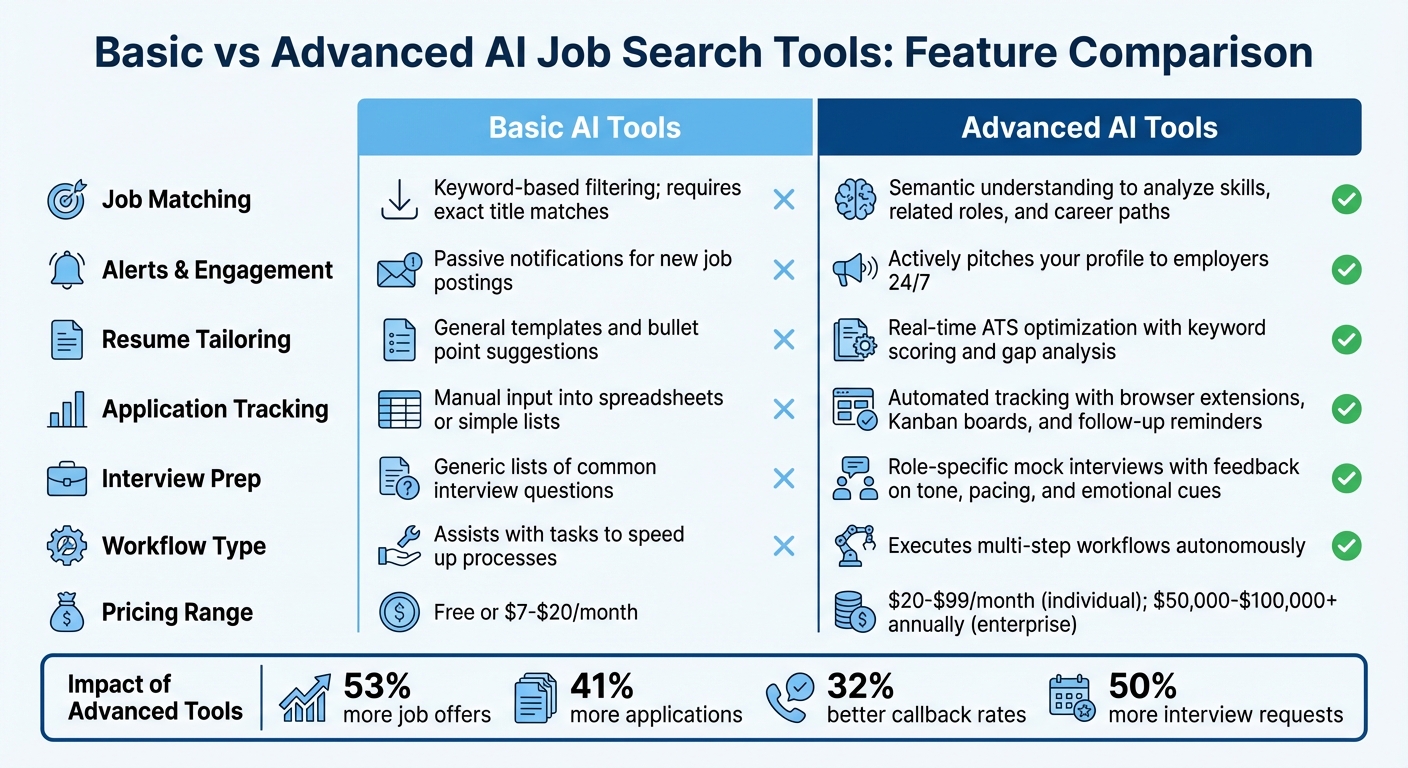
Basic vs Advanced AI Job Search Tools Feature Comparison
AI job search tools vary widely in functionality, from basic options requiring manual input to advanced platforms that automate essential processes like interview preparation.
Basic AI tools typically provide keyword-based job matching and simple notifications when new opportunities arise. While they can help you work more efficiently, you'll still handle the bulk of the process yourself. On the other hand, advanced platforms use semantic understanding to identify transferable skills and career patterns, even if specific keywords don’t align. As Adil, Co-founder of shortlistd.io, explains:
AI handles the 70-80% of work that's repetitive and data-driven, while human recruiters focus on the 20% requiring emotional intelligence.
For companies, advanced AI recruiting tools lead to a 40-60% reduction in time-to-hire and up to a 76% decrease in cost-per-hire. For job seekers, these tools can optimize resumes in ways that increase interview opportunities by up to 6x.
Here’s a detailed comparison of basic versus advanced AI tools to illustrate how these features can transform your job search:
| Feature | Basic AI Tools | Advanced AI Tools |
|---|---|---|
| Job Matching | Relies on keyword-based filtering; requires exact title matches | Uses semantic understanding to analyze skills, related roles, and career paths |
| Alerts & Engagement | Sends passive notifications for new job postings | Actively pitches your profile to employers around the clock |
| Resume Tailoring | Provides general templates and bullet point suggestions | Offers real-time ATS optimization with keyword scoring and gap analysis |
| Application Tracking | Requires manual input into spreadsheets or simple lists | Automates tracking with browser extensions, Kanban boards, and follow-up reminders |
| Interview Prep | Supplies generic lists of common interview questions | Conducts role-specific mock interviews with feedback on tone, pacing, and emotional cues |
| Workflow Type | Assists with tasks to speed up processes | Executes multi-step workflows autonomously |
| Pricing Range | Free or $7-$20/month | $20-$99/month for individual users; $50,000-$100,000+ annually for enterprise clients |
This breakdown highlights the advantages of advanced tools in making your job search more efficient. For example, JobLogr’s Premium plan, priced at $20/month, includes features like resume analysis, personalized cover letter creation, and interview preparation. Meanwhile, the free tier offers essential tools suitable for beginners.
Conclusion
The five features highlighted in this guide - smart job matching, resume tailoring, automated tracking, interview preparation, and security controls - combine to reshape how job seekers in the U.S. approach today's competitive job market. By automating tedious tasks like manual searching and data entry, these tools allow you to focus on what truly matters: networking and acing your interviews.
AI-driven tools have made a noticeable difference in job hunting. They increase the chances of receiving job offers by 53%, help users apply to 41% more positions, improve callback rates by 32%, and generate 50% more interview requests. These numbers emphasize the game-changing role AI plays in modern job searches.
JobLogr brings all these features together on a mobile-friendly platform for $20 per month. It offers automated job discovery, ATS-optimized resume analysis, tailored cover letter creation, and interview preparation customized to specific roles. Here's what one user had to say about their experience:
"I was spending way too much time jumping between LinkedIn, Indeed, and company career pages... Now I can track all my applications in one place and quickly customize cover letters without starting from scratch." - Lashell Thomas, Project Director
Lashell's experience highlights the platform's ability to simplify and streamline the job search process. Whether you’re actively applying or just exploring opportunities, JobLogr’s AI takes care of the hard work, leaving you free to focus on building your personal brand and making informed career decisions. Ready to speed up your job search? Visit https://joblogr.com and take the next step toward landing your dream role.
FAQs
How do AI job apps protect my personal information?
AI-powered job applications take your data security seriously, employing a range of measures to keep your information safe. For starters, they use encryption to safeguard your data, whether it’s being transmitted or stored. This ensures that sensitive details like your resume or contact information stay private and protected from unauthorized access.
Most platforms also follow a data-minimization policy, meaning they only retain the information you provide - such as your resume or job preferences - and either delete or anonymize it once it’s no longer required. This approach reduces unnecessary data storage and limits potential risks.
On top of that, many apps let you decide how your data is used. For example, you can often opt out of having your inputs contribute to improving AI models. To maintain high security standards, these platforms comply with regulations like the California Consumer Privacy Act (CCPA) and conduct regular security audits to address potential vulnerabilities.
Take JobLogr as an example - it incorporates these measures by offering encryption, short-term data retention, and privacy settings you can customize. With these features, your job search remains not only effective but also secure.
How does AI-powered resume tailoring improve your chances of landing a job?
AI-powered tools for resume tailoring give job seekers a real edge by quickly analyzing job descriptions and fine-tuning resumes to match specific roles. These tools pull out key skills and terms from the job posting, ensuring your resume aligns with what both recruiters and Applicant Tracking Systems (ATS) prioritize. The result? A faster, more accurate process compared to making edits manually, saving you valuable time while boosting your chances of clearing those initial screenings.
On top of that, these platforms offer personalized tips, like phrasing suggestions or formatting tweaks, based on what works in your industry. They even take into account your career stage and goals, helping you craft a resume that’s laser-focused and effective. With advanced algorithms at work, tools like JobLogr help you build data-driven, ATS-friendly resumes that increase your chances of landing interviews - and, ultimately, job offers.
How can AI-powered tools help me prepare for job interviews?
AI-powered tools can revolutionize the way you prepare for interviews by offering tailored, data-driven practice sessions. These tools create realistic questions that align with the specific role and company you're targeting, ensuring your preparation is focused and relevant. Plus, they evaluate your responses, giving feedback on clarity, structure (like the STAR method: Situation-Task-Action-Result), and technical precision.
With real-time insights, you can fine-tune your answers, work on your body language, and perfect your timing. This not only boosts your confidence but also sharpens your readiness. By efficiently addressing areas where you need improvement, you can significantly enhance your chances of standing out to hiring managers and landing the job.