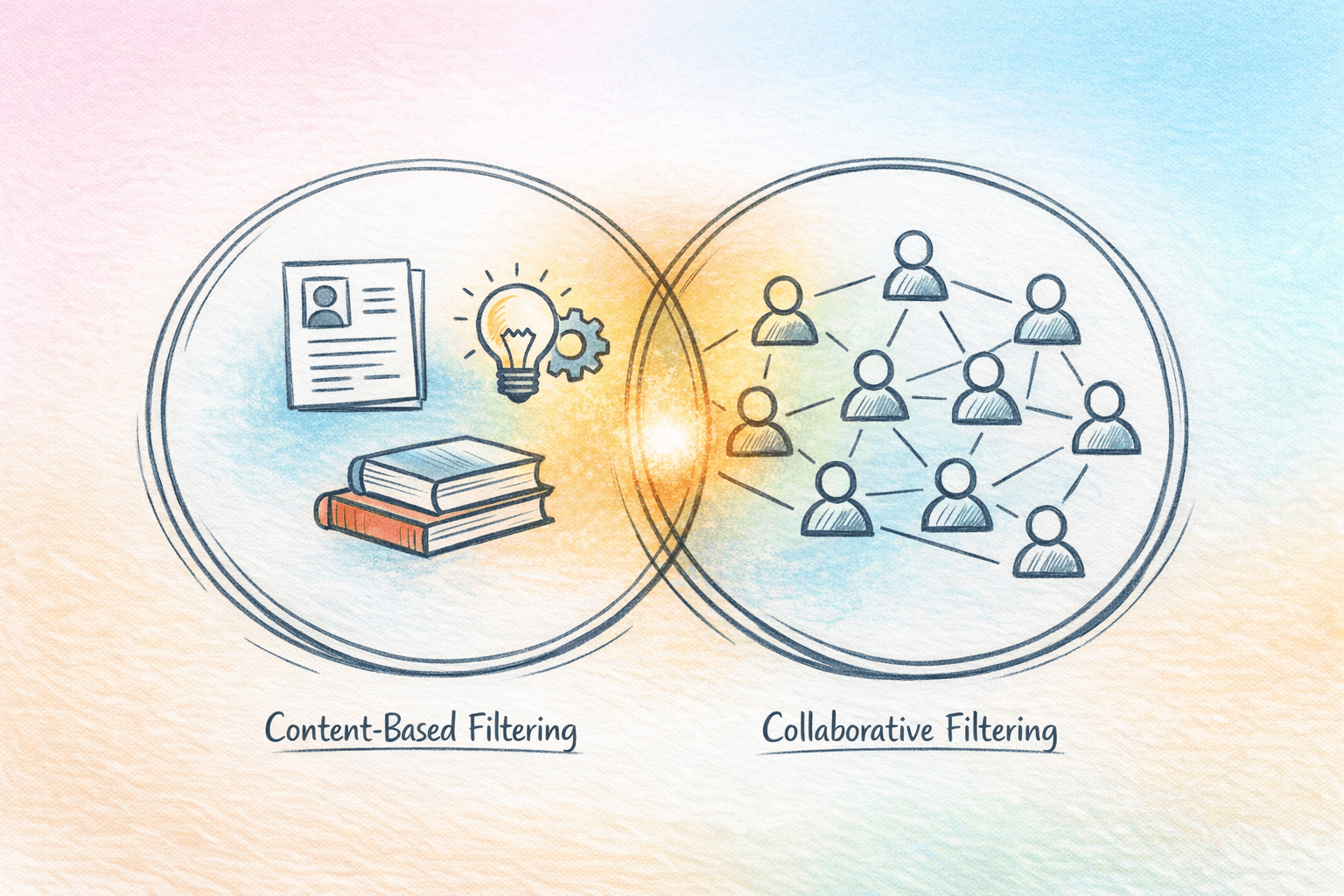
Content-Based vs Collaborative Filtering: Key Differences
When it comes to job recommendations, two major approaches dominate: content-based filtering and collaborative filtering. Here's a quick breakdown:
- Content-Based Filtering: Matches job details (like skills, titles, and locations) to your profile. It's great for precise matches and handles new job postings well. However, it may lead to repetitive suggestions (filter bubbles) and struggles with limited user data.
- Collaborative Filtering: Focuses on user behavior, leveraging patterns from others with similar interests. It uncovers unexpected opportunities but struggles with new users or jobs due to the "cold start" problem.
Both methods have unique strengths and challenges. Platforms often combine them in hybrid models to deliver more effective recommendations, balancing detailed job matching with broader discovery.
Quick Comparison
| Aspect | Collaborative Filtering | Content-Based Filtering |
|---|---|---|
| Primary Data Source | User behavior (clicks, applications) | Job details (skills, titles, metadata) |
| Cold-Start Problem | Affects new users and jobs | Handles new jobs well; struggles with new users |
| Recommendation Basis | Patterns in user behavior | Direct matching of job and user profiles |
| Diversity/Novelty | High; suggests unexpected roles | Low; may lead to repetitive matches |
| Explainability | Low; hard to justify recommendations | High; clear reasoning based on matches |
Platforms like LinkedIn and Netflix use hybrid systems to combine the strengths of both methods, ensuring better matches and broader opportunities. This approach helps address limitations like sparse data or repetitive suggestions while improving overall effectiveness.
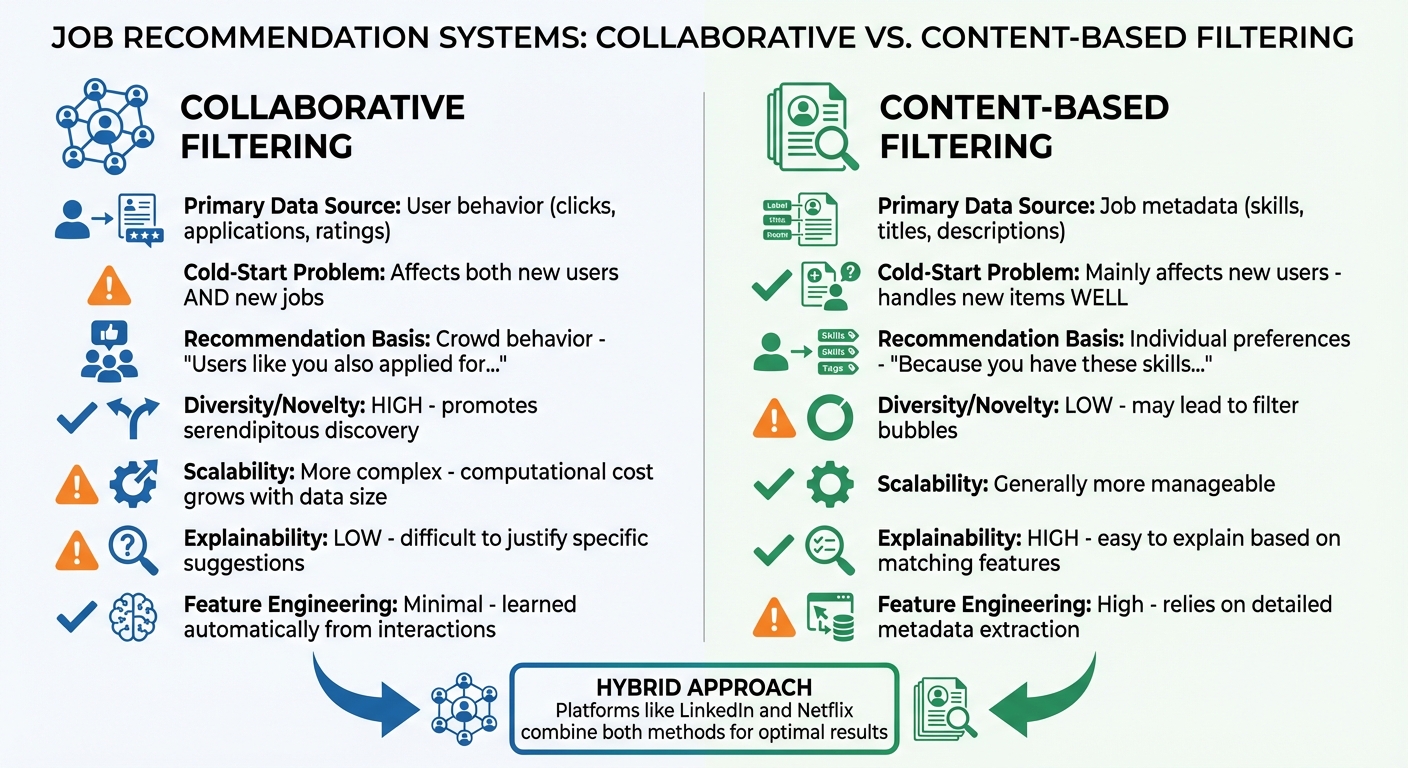
Collaborative vs Content-Based Filtering: Side-by-Side Comparison
Content Based Vs Collaborative Filtering|Recommendation system content based vs collaborative filter
What is Collaborative Filtering?
Collaborative filtering predicts what jobs might interest you by analyzing patterns in user behavior across job seekers. Instead of relying solely on keyword matches, it looks at shared actions. For instance, if you and another user have applied to similar roles in the past, the system assumes you might also be interested in opportunities that appealed to them in the future.
"Collaborative filtering works on the principle that users with similar behavior in the past are likely to have similar preferences in the future." - GeeksforGeeks
This method relies on tracking user engagement to build a user-item matrix, which organizes data by matching users to jobs. The values in this matrix can be explicit, like ratings, or implicit, such as whether you viewed or applied to a job.
The system uses similarity metrics, such as Cosine Similarity or Pearson Coefficient, to find connections between users and roles. This process often uncovers opportunities you might not have considered otherwise. Unlike traditional methods that match your resume directly to job requirements, collaborative filtering introduces roles that have attracted individuals with similar profiles or interests.
Types of Collaborative Filtering
Collaborative filtering typically follows three main approaches:
- User-based collaborative filtering: This method identifies other job seekers with similar engagement histories - your “neighbors” - and recommends jobs they’ve interacted with. For example, if you and another user both applied to senior roles at Google and Meta, and they also applied to a position at Netflix, the system may suggest the Netflix role to you.
- Item-based collaborative filtering: Instead of focusing on users, this approach looks at relationships between jobs. For instance, if many users who applied to a Data Analyst role at Amazon also applied for a Business Intelligence position at Microsoft, the system might recommend the Microsoft role to someone viewing the Amazon posting.
- Model-based collaborative filtering: This approach uses machine learning techniques like matrix factorization or neural networks to uncover deeper patterns in user behavior. These models create compact representations, or “embeddings,” of users and jobs in a shared space. For example, the system might detect hidden preferences, such as a liking for remote work or specific technical skills, and use that insight to recommend roles - even if you haven’t interacted with similar jobs before.
How Collaborative Filtering Works
The system continuously updates a user-item matrix based on interactions, grouping similar profiles to make efficient matches. By leveraging embeddings, it can find connections between users and jobs even when data is sparse - meaning most users have only interacted with a small portion of available roles. This process enables platforms to provide personalized recommendations.
However, one challenge is the cold start problem. When a new user or job has little to no interaction data, the system struggles to generate accurate recommendations. To address this, many platforms combine collaborative filtering with other techniques, like content-based filtering, during the early stages of a job search.
What is Content-Based Filtering?
Content-based filtering zeroes in on the details of jobs themselves, rather than relying on the behavior of other users. It digs into structured metadata - like required skills, job titles, industry, and location - to create a personalized profile based on your resume, search history, and job interactions.
"Content-based filtering is an information retrieval method that uses item features to select and return items relevant to a user's query." - IBM
This method builds individual profiles for both jobs and candidates. For instance, if your profile indicates frequent engagement with roles involving Python and cloud computing, the system will prioritize similar opportunities. Unlike collaborative filtering, it doesn’t depend on the preferences of other users, making it especially useful for niche career paths where user interaction data might be sparse.
The system converts both your profile and job postings into numerical vectors that represent various skills and attributes. By calculating similarity metrics, it identifies jobs that closely align with your profile. One standout advantage is its ability to recommend new job postings immediately. As long as a new position includes detailed metadata, it can be matched to your profile right away, effectively addressing the "cold start" problem. The next step - vectorizing and comparing profiles - explains how these matches are fine-tuned.
How Content-Based Filtering Works
The process starts with creating an item profile for each job listing. This profile captures everything from specific requirements (like "5 years of experience in data analysis") to broader features such as industry or company size. Meanwhile, a user profile is built by analyzing your resume, search history, and prior job interactions. Both profiles are then transformed into structured data through feature extraction. Natural Language Processing (NLP) often plays a key role here, converting unstructured job descriptions into organized feature sets.
Next comes vectorization, where these profiles are converted into numerical data points within a shared space. Attributes that frequently appear in your history - say, SQL expertise - are given more weight, making them strong signals in your profile. The system uses metrics like Cosine Similarity to measure the closeness between your profile and job vectors. These scores, ranging from -1 to 1, help rank jobs, with higher-scoring matches appearing at the top of your recommendations. This approach ensures that even new job listings can be matched to your profile as soon as they are added.
"The richer the metadata, the easier it is to implement content-based filtering and the better the results." - Redis
Key Features of Content-Based Filtering
Content-based filtering relies heavily on detailed job metadata to deliver tailored recommendations. It excels at aligning your profile with job attributes in a transparent way. However, its focus on your established preferences can sometimes create "filter bubbles", limiting exposure to diverse opportunities. To address this, many AI-driven job platforms integrate additional methods to balance personalized suggestions with the discovery of fresh possibilities.
Key Differences Between Collaborative and Content-Based Filtering
Collaborative filtering relies on the collective behavior of users, while content-based filtering focuses directly on matching job attributes to a user's skills. Collaborative filtering assumes that users who have shown similar preferences in the past will continue to do so in the future, basing its recommendations on patterns of crowd behavior. On the other hand, content-based filtering works independently of user behavior, aligning job attributes with your profile to generate matches. This sets up a clear distinction between the two approaches.
One of the standout features of collaborative filtering is its ability to uncover unexpected opportunities, often surfacing roles that users might not have considered. However, it struggles with new job listings until enough user interaction data is available. In contrast, content-based filtering adapts quickly to new postings by relying solely on job details, offering precise matches from the start. Collaborative filtering thrives by identifying roles popular among similar users, while content-based filtering excels in accuracy by focusing on the specifics of job descriptions.
"Collaborative filtering can recommend items that a target user may have not considered but that nevertheless appeal to their user type." - Sachi Nandan Mohanty et al., Recommender System with Machine Learning and Artificial Intelligence
Another key difference lies in how these systems explain their recommendations. Content-based filtering provides transparent suggestions, such as "This job matches your Python skills and data analysis experience." Collaborative filtering, however, functions more like a black box, generating recommendations based on complex patterns across large datasets without clear explanations. This lack of transparency can make it harder to understand why certain roles are suggested. These distinctions, including factors like scalability and feature requirements, are summarized in the table below.
Comparison Table
| Aspect | Collaborative Filtering | Content-Based Filtering |
|---|---|---|
| Primary Data Source | User-item interactions (clicks, applications, ratings) | Item metadata and user profile features (skills, job descriptions) |
| Cold-Start Problem | Affects both new users and new items | Mainly affects new users; handles new items well |
| Recommendation Basis | Crowd behavior ("Users like you also applied for...") | Individual preferences ("Because you have these skills...") |
| Diversity/Novelty | High; promotes serendipitous discovery | Low; may lead to repetitive suggestions (filter bubble) |
| Scalability | More complex; computational cost grows with data size | Generally more manageable, depending on feature extraction |
| Explainability | Low; it is difficult to justify specific suggestions | High; recommendations are easy to explain based on matching features |
| Feature Engineering | Minimal; learned automatically from interactions | High; relies on detailed metadata extraction |
sbb-itb-6487feb
Advantages and Limitations of Collaborative Filtering
Advantages
Collaborative filtering shines when it comes to finding career opportunities that go beyond the obvious. By analyzing patterns in user behavior, it can suggest roles that may not perfectly align with a resume but still match similar professional preferences. This can open doors to unexpected opportunities, including lateral career moves or roles a candidate might not have considered.
One of its strengths is that it doesn’t rely heavily on manual tagging. Instead of painstakingly categorizing every skill or certification, the system learns directly from user actions - like clicks, job applications, or saved postings. This makes it particularly useful for roles that are harder to define or where job descriptions are incomplete.
"Collaborative filtering can recommend items that a target user may have not considered but that nevertheless appeal to their user type." - Sachi Nandan Mohanty et al., Recommender System with Machine Learning and Artificial Intelligence
Limitations
While powerful, collaborative filtering does come with its challenges. One major issue is the cold-start problem: recommendations are tough to generate when there’s little to no interaction data, especially for new users or listings. Sparse interaction data further complicates things, as most job seekers engage with only a small slice of available opportunities, making it harder to identify reliable patterns.
Another hurdle is the sheer computational effort required to process large-scale interaction data, which can slow down real-time recommendations. Plus, there’s the risk of feedback loops - where the system keeps suggesting similar types of roles based on past behavior, potentially limiting a candidate’s exposure to new or diverse opportunities. These challenges are why many platforms pair collaborative filtering with other recommendation methods to ensure better results.
Advantages and Limitations of Content-Based Filtering
Advantages
Content-based filtering brings a lot to the table, especially when it comes to accuracy and speed. One standout feature is that it doesn't rely on group behavior or user interactions to work. Instead, it focuses on specific job details - like required skills, location, and job title - making it an excellent choice for platforms with limited user data or low traffic.
A major plus is how it handles new job postings. By using metadata, it can instantly match new roles to user profiles, avoiding the cold-start problem that plagues many recommendation systems. This straightforward process also builds trust, as users can clearly see how their skills align with job requirements.
If you have a unique skill set or a mix of rare expertise, content-based filtering is a game changer. For example, if you're searching for a role that combines machine learning knowledge with healthcare experience, this system can pinpoint those niche opportunities. Its focus on individual profiles ensures that recommendations are tailored specifically to you, rather than influenced by what others are viewing or applying for.
Limitations
However, this approach isn't without its downsides. One of the biggest challenges is overspecialization. If you're focused on "Data Analyst" roles, for instance, the system might miss related opportunities like "Business Intelligence Analyst" or "Data Scientist." This creates a "filter bubble", where you only see narrow, repetitive options and miss out on discovering new career paths or adjacent roles.
Another limitation is its reliance on metadata. If a job description is poorly written - lacking a skills section or using inconsistent terminology - the system might fail to identify a perfect match. Unlike collaborative filtering, it doesn't naturally pick up on less tangible factors like company culture or work-life balance unless advanced natural language processing is integrated. And while it excels at matching new job postings, it struggles with new users who haven’t provided enough data to generate meaningful recommendations.
Balancing these pros and cons is crucial for building job recommendation systems that truly meet user needs.
Hybrid Approaches: Combining Both Methods for Better Job Recommendations
Hybrid models bring together the strengths of content-based and collaborative filtering, addressing the challenges and limitations of each method to create a more effective job recommendation system.
Strategies for Hybrid Models
These strategies focus on blending the best of both worlds to meet the demands of modern job recommendation systems. Hybrid models often combine content-based matching (which uses job metadata) with collaborative filtering (which relies on user behavior patterns). By assigning weighted scores to each method, the system ranks job recommendations more effectively. This integration results in recommendations that are both precise and flexible.
"Challenges of content and collaborative filtering can be solved by using hybrid filtering. Hybrid filtering combines the features of two recommender system like content and collaborative; content-based filtering improves the classification accuracy and collaborative model easily gives the best-predicted result of a latent factor model." – Ravita Mishra, Thakur College of Engineering and Technology
Fallback mechanisms play a crucial role in hybrid systems. For instance, when new job postings lack interaction data, content-based filtering steps in, relying on metadata to match candidates. As user interaction data becomes available, collaborative filtering refines these recommendations, making them more accurate over time.
Another key advancement is the use of semantic embeddings from pre-trained language models. These models transform unstructured job descriptions and resumes into vector representations for better matching. Tools like Redis, paired with vector similarity search, allow platforms to efficiently process millions of job-candidate pairs.
Why Hybrid Models Work in Job Searches
Hybrid models effectively tackle challenges like data sparsity by combining the strengths of collaborative filtering, which identifies hidden patterns, and content-based filtering, which bridges gaps in metadata.
Real-world examples highlight their success. Netflix employed a hybrid system during the "Netflix Prize" competition, and LinkedIn's Job Ecosystem uses a similar approach to improve recommendation accuracy and handle cold start issues. This dual strategy avoids the pitfalls of pure content-based systems, such as overspecialization, while maintaining transparency in recommendations.
Conclusion: Choosing the Right Approach for Job Search Platforms
Selecting the best recommendation approach hinges on factors like the platform's data availability, maturity, and the needs of its users. For newer platforms or freshly added job postings, content-based filtering works well by focusing on matching specific skills and qualifications. On the other hand, collaborative filtering shines on platforms with substantial user activity, uncovering unexpected opportunities through shared user behavior.
A more advanced solution combines the best of both worlds. Hybrid models, which integrate content-based and collaborative filtering, have proven highly effective for mature platforms. Take Netflix, for example - it uses a hybrid system to blend user behavior with content metadata, significantly improving its recommendation accuracy. The same logic applies to job search platforms, where this approach balances precise skill matching with the potential for discovering unexpected career paths.
"In practice, many systems employ a hybrid approach, combining both methods to leverage the advantages of each and mitigate their respective limitations." – Bugfree.ai
JobLogr exemplifies this dual strategy by refining its recommendations to meet diverse user needs. It employs content-based filtering to handle new job postings while leveraging collaborative filtering to identify patterns among similar professionals. This approach not only tackles data sparsity but also minimizes decision fatigue, ensuring users are exposed to relevant opportunities without being confined to repetitive or overly narrow suggestions.
For platforms just starting out, content-based filtering offers a solid foundation to cover all job postings. As the platform grows and gathers more user data, collaborative filtering can be introduced to enhance discovery. This step-by-step progression ensures that platforms maintain high-quality recommendations as they scale, ultimately helping job seekers find opportunities more efficiently and with greater relevance.
FAQs
How do hybrid models enhance job recommendations?
Hybrid models enhance job recommendations by merging content-based filtering with collaborative filtering. This method uses both job-related details (like descriptions) and user behavior (such as past applications) to create a more tailored and precise matching experience.
These models tackle challenges like the cold-start problem - where limited data exists for new users or job listings - and data sparsity, which occurs when there aren't enough user interactions. By addressing these issues, hybrid models make it easier for job seekers to find positions that match their skills, interests, and long-term career aspirations.
What challenges does collaborative filtering face?
Collaborative filtering excels at suggesting items by analyzing user similarities, but it comes with its own set of challenges.
One of the biggest hurdles is the cold-start problem. When new users or items are added to the system, there isn’t enough interaction data to generate reliable recommendations. This lack of information makes it tough to provide meaningful suggestions right away.
Another issue is data sparsity. Most users interact with only a small fraction of the available items, which limits the system’s ability to identify strong patterns. On top of that, as platforms grow, scalability becomes a concern. Comparing millions of users or items requires a lot of computational power, which can slow things down significantly.
To overcome these challenges, many platforms - like JobLogr - combine collaborative filtering with content-based approaches. This hybrid method helps create more accurate and tailored recommendations, even in tricky scenarios.
Why does content-based filtering sometimes suggest similar types of jobs repeatedly?
Content-based filtering works by analyzing the details of the jobs you've already engaged with - things like job titles, required skills, or the industries they belong to. This approach can deliver tailored job suggestions that align closely with your past interactions. However, there’s a downside: it might keep recommending jobs that are too similar to what you’ve already explored. This lack of variety can make it harder to discover opportunities that fall outside your usual preferences, potentially limiting your career horizons.