How AI Analyzes Skill Gaps for Career Shifts
Switching careers can feel overwhelming, but AI is making it faster and easier to identify and close skill gaps. Here’s how:
- AI speeds up skill gap analysis: What used to take 40 hours manually now takes just 12 minutes.
- Improved accuracy: AI matches skills to job requirements with 90–93% precision.
- Focus on transferable skills: AI identifies skills that are 2.3x more relevant for career changes.
- Better job search results: Professionals using AI see faster transitions (reducing job search time by 47%) and higher ATS match rates (up to 30%).
AI tools analyze resumes, LinkedIn profiles, and even project data to create a detailed skill profile. They compare your current skills with job requirements, rank gaps by importance, and recommend targeted learning plans. This data-driven approach helps you focus on high-demand skills, boosting your chances of landing interviews and better offers.
Bottom line: AI transforms career transitions by providing clear, actionable steps to bridge skill gaps and align with market needs.
How AI Is Changing the Skills Employers Look For
sbb-itb-6487feb
What Is Skill Gap Analysis for Career Changes
AI vs Traditional Skill Gap Analysis: Speed, Accuracy and Scalability Comparison
Defining Skill Gaps
A skill gap is simply the difference between the skills you currently have and the ones required for a specific role or career path. Think of it as a roadmap that highlights exactly where you need to improve.
Here’s why addressing these gaps matters: 99% of Fortune 500 companies use Applicant Tracking Systems (ATS) that filter resumes based on specific skills and keywords. If your resume doesn’t align, it may never even reach a human recruiter. And even if you land a job, ignoring skill gaps could lead to salary offers that are up to 15% lower than the average.
But there’s good news. Professionals who actively identify and address their skill gaps often shorten their job search from 5–7 months to just 3–4 months. Instead of spreading your efforts across generic upskilling, focusing on high-priority, in-demand skills can make you stand out to hiring managers and even lead to better compensation.
Now, let’s dive into how AI is transforming this process, making skill gap analysis faster and more precise.
How AI Improves Skill Gap Analysis
Traditional skill gap analysis has its challenges - it’s slow, subjective, and often misses key details. Manual methods like keyword matching, surveys, and self-assessments can take weeks or even months to complete. These approaches also leave room for bias and may fail to uncover critical, less obvious abilities.
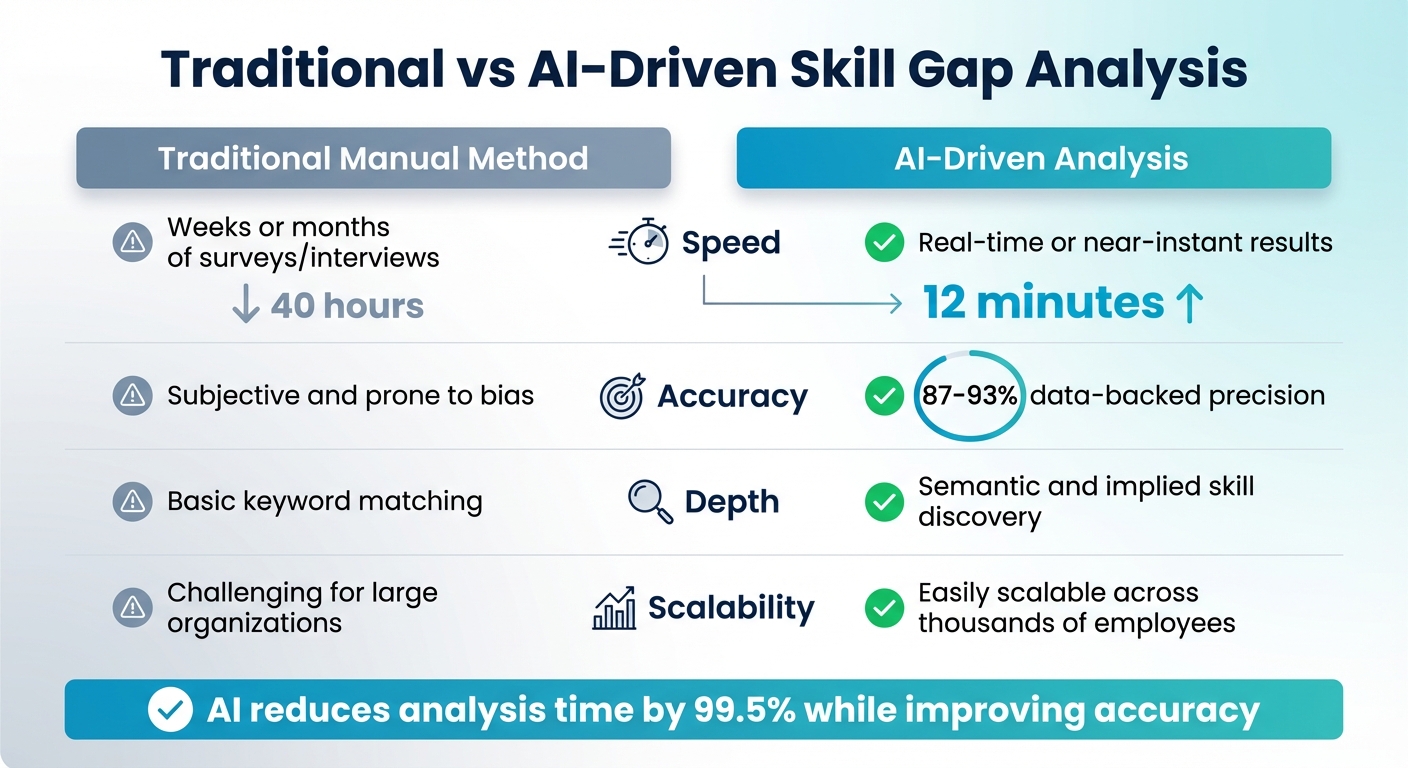
AI takes this process to a whole new level. It cuts manual research time from 40 hours to just 12 minutes. Using Natural Language Processing (NLP), AI can analyze job descriptions and resumes to understand the context behind the words. It doesn’t stop at surface-level keywords - it identifies hidden skills. For example, if your resume mentions "led diverse teams", AI recognizes this as evidence of leadership and stakeholder management abilities.
| Feature | Traditional Manual Method | AI-Driven Analysis |
|---|---|---|
| Speed | Weeks or months of surveys/interviews | Real-time or near-instant results |
| Accuracy | Subjective and prone to bias | 87–93% data-backed precision |
| Depth | Basic keyword matching | Semantic and implied skill discovery |
| Scalability | Challenging for large organizations | Easily scalable across thousands of employees |
Platforms like JobLogr (https://joblogr.com) are already using AI to provide actionable insights. These tools help you quickly pinpoint the most sought-after skills for your target role, so you can focus on what really matters.
AI doesn’t just stop at identifying gaps. It taps into millions of job postings and industry databases to rank missing skills by their market demand and salary potential. For example, Johnson & Johnson rolled out an AI-powered "skills inference" program for 4,000 technologists in early 2020. By March 2024, this initiative led to a 20% increase in voluntary learning activities, with over 90% of their Technology group actively using the AI-driven system to close skill gaps.
With AI, skill development becomes laser-focused, ensuring you’re aligned with both employer needs and industry trends.
How AI Evaluates Your Current Skills
Before diving into what you’re missing, AI first takes a close look at what you’ve already got. The process kicks off as soon as you upload your resume or link your professional profiles. But AI doesn’t just scan for keywords - it builds a detailed skill profile by pulling data from multiple sources.
Where AI Pulls Data for Skill Profiling
Your skill profile serves as the foundation for identifying gaps, so AI casts a wide net to gather information. It starts with your resume (whether it’s a PDF or DOCX file) but doesn’t stop there. Platforms also analyze your LinkedIn profile, focusing on sections like Summary, Experience, and Skills & Endorsements to uncover skills you might not have included on your resume.
For those in technical fields, AI can even dig into your GitHub repositories, identifying programming languages, tools, and frameworks you’ve used in real-world projects. If you’ve taken online courses, some systems check Learning Management Systems (LMS) to find certifications you’ve earned and topics you’ve studied.
The real magic lies in what’s called "skills evidence" - actual proof of your abilities. This might include data from project management tools like Jira or Asana, portfolios, work samples, or even presentations you’ve created. Instead of relying solely on what you say you know, AI looks for measurable results and context to verify your expertise.
How AI Analyzes and Measures Skills
Once your data is collected, AI uses advanced techniques to interpret it. Through Natural Language Processing (NLP), it identifies critical terms like "Python", "Agile Scrum", or "team leadership". Then, with word embeddings (using models like BERT or GloVe), it recognizes variations and synonyms - for example, treating "C#" and "C Sharp" as the same skill.
AI doesn’t stop at surface-level analysis. Word embeddings transform skill terms into mathematical vectors, capturing their deeper meanings. This allows AI to connect related terms, such as understanding that "data analytics" and "data analysis" refer to the same expertise. These models boast over 90% precision when matching technical skills to job requirements.
To take things further, clustering algorithms group related skills under broader categories. For instance, "SQL", "Tableau", and "Power BI" might be grouped under "Data Visualization", while "JavaScript", "React", and "Node.js" could fall under "Web Development". This approach highlights patterns in your skill set, including strengths you might not have noticed.
AI also identifies transferable skills that work across different roles. For example, if your resume mentions "managed a cross-functional team of 10", AI might infer leadership, stakeholder management, and communication skills.
In December 2023, LinkedIn introduced a "Skills Graph" powered by a multitask cross-domain scoring model. This update improved how transferable skills were matched to job requirements, leading to a 0.46% increase in predicted confirmed hires.
"Adopting a skills-first approach will be especially critical as the requirements for roles, businesses, and industries are rapidly changing amid the current generative AI (GAI) boom." - Ji Yan, Tech Lead, LinkedIn AI
The end result? A comprehensive skill profile that doesn’t just reflect what you’ve listed but also highlights what you’ve demonstrated through your work. Often, this process uncovers strengths you didn’t even know you had, setting the stage to pinpoint exactly what you need for your next career move.
Finding and Displaying Skill Gaps for Your Target Role
Once AI has assessed your current skill set, the next step is to measure how it stacks up against the requirements of your desired job. This is where the system shifts from profiling to benchmarking - comparing your abilities to real-world job expectations.
Matching Your Skills to Specific Roles
AI begins by analyzing job descriptions for the role you're aiming for, creating a "skill blueprint" tailored to that position. It goes beyond simple keyword matching by leveraging semantic similarity analysis through tools like BERT and SBERT, which understand the context behind your experience. For instance, if a role mentions "container orchestration" and your resume lists "Kubernetes", AI identifies these as related skills.
The system also cross-references your profile with industry-standard skill taxonomies such as O*NET or ESCO. This feature is particularly useful for those switching careers, as it highlights transferable skills that may be described differently across industries. For example, "stakeholder communication" in healthcare could correspond to "client relationship management" in consulting.
To ensure accuracy, AI typically analyzes 3-5 job postings for the same role, capturing a broader range of employer needs. It then generates metrics to quantify your readiness and gaps, including Gap Scores (on a 0-100 scale), Skill Similarity scores, and Readiness Scores. Platforms like LinkedIn evaluate over 41,000 unique skills across 6,000+ job titles to calculate these scores.
Once these metrics are established, AI presents your skill gaps in user-friendly, visual formats.
How AI Tools Display Skill Gaps
The data AI gathers is transformed into visual tools that make it easy to pinpoint areas for improvement. These include Gap Report Tables, Transferability Scorecards, and Impact-Effort Matrices, all designed to provide actionable insights.
- Gap Report Tables: These outline each skill with a status of "Present", "Partial", or "Missing". Some tools also include numerical scores showing your current proficiency compared to the target level. For example, if you score a 30 in Docker but the role requires an 80, the table highlights a gap of 50 points.
- Transferability Scorecards: Ideal for career changers, these scorecards display your current proficiency, the skill's relevance to the target role, and a star rating (★★★★★) indicating how easily the skill transfers.
- Impact-Effort Matrices: These grids help prioritize skill development by comparing hiring value against learning time. They emphasize "high-impact, low-effort" skills - those that are essential for the role and can be learned quickly through certifications or short courses lasting just 2-4 hours.
Some platforms, like LinkedIn, even use Venn diagrams to show overlapping skills between your current and target roles. Skills that are less common between the two are placed further from the center.
Research shows that AI-driven skill gap analysis aligns with recruiter-identified gaps 87% of the time and can boost your ATS match rate by up to 30%. Considering that 75% of recruiters use keyword filters before a human reviews your resume, knowing exactly what you're missing - and how to address it - can be the key to landing an interview. These tools not only highlight gaps but also guide you toward targeted skill development, helping you focus on areas that will make the biggest impact.
Ranking Skills by Priority for Development
AI Recommendations for High-Priority Skills
Not every skill gap is worth the same level of attention. AI helps zero in on the most impactful skills by analyzing factors like market demand, salary potential, and learning time. By sifting through millions of job postings and government data, AI identifies emerging skills that are gaining traction [20,21].
Each skill is assigned a weighted score based on metrics like year-over-year growth (typically exceeding 15% for top-priority skills), how often it appears in job descriptions, and the salary benefits it offers [21,3]. Predictive modeling tools, such as ARIMA, further enhance these insights by forecasting demand up to a year ahead, helping you avoid investing in skills that might soon lose relevance.
To make this data actionable, the Impact-Effort Matrix comes into play. This tool evaluates each skill's hiring value against the effort required to learn it. Skills that land in the high-impact, low-effort category - those critical to your role and achievable in a couple of weeks through tutorials or micro-credentials - should be your first focus. For example, Johnson & Johnson used AI to evaluate 4,000 technologists on 41 "future-ready" skills. This initiative led to a 20% boost in professional development engagement and closed 90% of skill gaps by March 2024.
"What makes you successful today won't make you successful three years, five years, or 10 years from now." - Nick van der Meulen, Research Scientist, MIT CISR
Once your key skill gaps are identified and ranked, AI creates a tailored learning strategy to help you address these efficiently.
Custom Learning Plans from AI
After identifying your top-priority skills, AI builds a personalized learning path that fits your career goals and timeline. It suggests specific courses from platforms like Coursera or Udemy, alongside certifications or micro-credentials, to target your three to five most critical skill gaps [3,2]. For example, AI might recommend a four-week machine learning course followed by AWS certification, ensuring your learning efforts are both focused and effective [3,20].
AI leans toward micro-learning - short, focused modules lasting two to four hours per skill - rather than lengthy, theory-heavy courses. Take the case of a marketing analyst transitioning into data science. She identified gaps like Python, machine learning, and Docker. The AI recommended a four-week course and a hands-on project, which led to three interview calls within two months. Another professional, focusing on Python and ETL pipelines, completed a "Python for Data Science" course and earned an AWS certification. The result? Twelve interview invitations and a job offer with a 30% salary increase.
The learning plan isn’t static. AI advises re-evaluating your progress every four to six weeks or after major projects to ensure your skills stay aligned with market demands, maximizing your career growth [1,3].
Creating and Following Your Skill Development Plan
Building Your Development Plan
Once AI pinpoints and ranks your skill gaps, the next step is turning that insight into a solid action plan. Start by setting SMART goals - goals that are Specific, Measurable, Achievable, Relevant, and Time-bound. Use AI-provided data, like salary trends and skill demand, to shape these goals. For instance, instead of vaguely deciding to "learn Python", you could aim to complete a four-week Python for Data Science course and create a portfolio project by a specific deadline.
To prioritize your efforts, use the Impact-Effort Matrix. This tool helps organize your skill gaps based on their importance and the effort required to address them. Focus on high-impact, low-effort skills first - these are the ones you can master quickly, often within a week or two, using tutorials or brief courses. Pair each priority skill with AI-recommended resources like Coursera specializations, Udemy courses, or certification programs. Then, schedule your learning activities with clear milestones - quarterly goals, monthly reviews, and weekly study blocks of 3–4 hours to keep yourself on track.
Your plan should remain flexible. For example, Sarah, a marketing analyst transitioning to data science, identified a 65% gap in Python and an 80% gap in machine learning. Within two months, she completed a four-week Python course, containerized a Kaggle project using Docker, and landed three interview calls.
Once your goals and timeline are set, the next step is tracking your progress with AI tools.
Monitoring Your Progress with AI
AI doesn't just help you create a plan - it also helps you stay on track. Tools like Skills Matrix Dashboards provide a visual overview of your progress. These dashboards use heat maps or color-coding (red for gaps, green for mastery) to show how your proficiency levels improve over time. They can even pull data from learning platforms automatically through integrations like Zapier, saving you the hassle of manual updates.
Another helpful metric is the Job Match score, which compares your evolving skill set to live job postings. This real-time feedback shows how your new skills make you a stronger candidate and keeps you motivated to continue learning. To stay consistent, set aside just 30 minutes each week - say, every Friday - for a "career sprint." Use this time to review your dashboard, adjust your learning schedule, and celebrate small victories. Studies show that professionals who regularly track their progress are 31% more likely to earn a promotion within two years.
Every three to six months, re-run your AI skills gap analysis to stay aligned with new industry trends. For example, Johnson & Johnson used this approach with 4,000 technologists between January 2020 and March 2024. By measuring proficiency in 41 "future-ready" skills, they boosted professional development engagement by 20%. By March 2024, 90% of their technologists had used the learning platform to address their skill gaps.
"People need to understand that skills are dynamic. What makes you successful today won't make you successful three years, five years, or 10 years from now".
- Nick van der Meulen, Research Scientist at MIT CISR
Conclusion
AI has reshaped how professionals navigate career changes. What once required up to 40 hours of manual research can now be done in just 12 minutes. By analyzing your skills against thousands of job postings, AI eliminates much of the guesswork, achieving 90% to 92% accuracy in matching your abilities to the right roles.
This technology boosts career transition success rates by 3.1× and speeds up the process by 47%. It excels at identifying both technical and transferable skills, making it 2.3× more effective for cross-industry transitions. With 75% of recruiters relying on keyword filters, aligning your skills precisely with job requirements becomes crucial.
Platforms like JobLogr take these advancements further. Their AI tools analyze resumes, pinpoint skill gaps, and tailor application materials to specific roles. The resume analysis feature ensures your documents use the exact terms Applicant Tracking Systems (ATS) look for, increasing ATS match rates by up to 30%. You can even try it risk-free with a 7-day free trial and money-back guarantee, while also creating a targeted plan for skill development.
As the job market evolves, staying ahead is essential. The World Economic Forum projects that 50% of the workforce will need reskilling by 2027. Regular AI-powered skill audits can help you adapt to these changes, turning uncertainty into opportunity. With AI as your partner, career transitions become a strategic move, perfectly aligned with market trends and demands.
FAQs
How does AI identify transferable skills for career changes?
AI can help identify transferable skills by examining your professional experience - like your resume or work history - and matching your current abilities with the needs of a different career or industry. It zeroes in on key strengths such as communication, leadership, problem-solving, or technical expertise like project management or data analysis, which are valuable across multiple roles.
Through methods like skill mapping and inference, AI assesses how your existing skills fit the requirements of a new position. It also identifies gaps in your skill set and provides actionable advice, helping you prepare for a career shift and emphasize the abilities that matter most.
How does AI identify skill gaps when transitioning to a new career?
AI can spot where your skills might be lacking by analyzing details like your resume, LinkedIn profile, or other professional data. It matches this information against the qualifications needed for your target role, identifying areas where you might need improvement. This comparison acts as a guide, showing you exactly which skills to work on.
Using Natural Language Processing (NLP), AI digs into job descriptions and industry benchmarks to pull out the skills that matter most. It can also tap into resources like certification databases or online learning platforms to suggest courses or credentials that align with your goals. With these combined insights, AI offers clear, practical steps to help you get ready for your next career opportunity.
How can AI help me identify and address skill gaps for a career change?
AI can play a key role in helping you bridge skill gaps by analyzing your existing abilities and comparing them to the qualifications needed for the role you’re aiming for. This gives you a clear picture of where to focus your efforts, so you can prioritize the skills that matter most for your career transition.
On top of that, AI tools can fine-tune your resume and application materials to match job descriptions and include relevant keywords. This boosts your chances of getting through Applicant Tracking Systems (ATS), which many employers use to filter candidates. By leveraging AI to address skill gaps and polish your application, you can position yourself as a strong contender and improve your odds of landing the job you want.